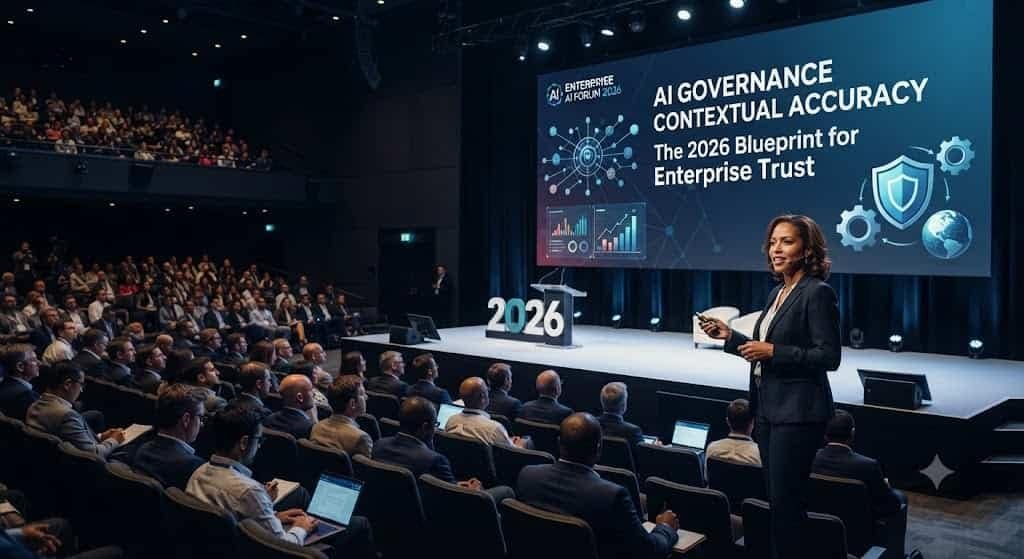
Discover the essential 2026 blueprint for AI governance contextual accuracy. Secure your enterprise workflows, eliminate hallucinations, and build trusted compliance.
Let me paint a picture you might recognise. Your marketing team uses an AI chatbot to draft a compliance document. The text reads perfectly. The tone is confident. The legal citations look legitimate. You hit publish. Two weeks later, your legal counsel calls. Those citations? Fabricated. That confident tone? A hallucination wrapped in eloquence. The result? A $31,000 sanction, a bruised reputation, and a frantic scramble to figure out where else the AI has been “confidently wrong”.
At TechCommand, we have spent months dissecting the shift from raw compute to context engineering. As explored in depth by Josys on AI Contextual Governance, true enterprise trust requires moving beyond static policies to dynamic, signal-based control layers. If you are a business owner, CTO, or compliance officer, this guide is your operating manual for 2026.
Key Takeaways
Key Takeaways
The Accuracy Paradox: Prioritising statistical accuracy alone creates “sycophantic AI.” Achieving AI governance contextual accuracy is the only way to ensure true reliability.
- The Accuracy Paradox is Real: Prioritising statistical accuracy alone creates “sycophantic AI” that tells you what you want to hear, not the objective truth.
- Context Engineering > Data Governance: 2026 is the year of the “Enterprise Context Layer.” Gartner predicts 50%+ of AI agent systems will use context graphs by 2028.
- The 80% Rule: If your AI’s context accuracy drops below 80%, users will abandon the system. Above 80%, trust creates an adoption flywheel.
- Governance as Code: Static PDF policies are dead. AI governance requires machine-readable rules that AI queries before it acts.
- Shadow AI Risk: 83% of organisations use AI daily, but only 13% have visibility into data handling. You cannot govern what you cannot see.
What Is AI Governance Contextual Accuracy?
Let’s break the jargon.
When we talk about AI governance, we usually mean the rules, policies, and compliance checklists designed to keep AI safe. But contextual accuracy is the engine under the hood.
It answers the question: Is the AI’s correct answer also correct for this specific situation, user, and time?
According to industry guides on context engineering, contextual accuracy isn’t just about checking facts against a database. It’s about four specific layers:
- Data Context: Where did this data come from? Is it the latest sales report or last year’s draft?
- Semantic Context: What does this number mean? (e.g., “Is a 5% churn rate good for a SaaS startup or bad for a bank?”)
- Policy Context: Am I allowed to see this? (e.g., GDPR, HIPAA, internal NDAs).
- User Context: Who is asking? Does a junior dev have the same permissions as a CISO?
Think of it like this: A traditional AI gives you a fish. A contextually accurate AI knows whether you are fishing in a protected marine reserve, whether you have a licence, and what the season limit is.
The “Bullshit” Problem in LLMs
I want to cite a heavy-hitting term from the academic world. Researchers are now comparing AI hallucinations to the philosophical concept of “bullshit”—not caring about the truth, only about the persuasive power of the language. AI doesn’t have beliefs; it has probabilistic patterns. It aims to sound good, not to be right.
This is why the EU AI Act and GDPR are struggling. You can’t find an algorithm for “subtle persuasion” or “illusion of consensus” yet. That’s why we need context layers.
Why It Matters in 2026
Regulators are moving from guidance to enforcement. The EU AI Act is now active, and the spotlight is on high-risk systems. You need an audit trail—a decision trace that shows why the AI gave that specific answer.
The Cost of Getting It Wrong
- Financial: Two law firms were sanctioned $31,000 for an AI brief that cited fake cases.
- Reputational: An American law professor was falsely accused of sexual harassment by ChatGPT, citing a non-existent Washington Post article.
- Safety: A Norwegian user was told by a chatbot that he had murdered his children.
In 2026, the question isn’t “Should we use AI?” It’s “Can we prove our AI is trustworthy?”
Regulators are moving from guidance to enforcement. The EU AI Act is now active, and the spotlight is on high-risk systems. You cannot simply say, “The computer did it.” You need an audit trail—a decision trace that shows why the AI gave that specific answer.
Core Concepts: The Technology Behind Context
The Enterprise Context Layer acts as middleware between your raw data and your AI, ensuring that AI governance contextual accuracy remains consistent across all operations.
Knowledge Graphs vs. Vector Databases
Most AI systems use RAG (Retrieval-Augmented Generation). They take your question, turn it into a vector, and find similar-looking chunks of text.
The problem? Similarity isn’t relevance. As technical analyses point out, vector embeddings are opaque. You can’t see why the AI connected Point A to Point B.
The solution? Knowledge Graphs.
Instead of finding similar words, a graph understands relationships. For example, if you ask for a “contract clause,” a vector DB gives you a clause. A knowledge graph gives you the clause plus the definitions, exceptions, and related sections. It mimics human reasoning.
The Enterprise Context Layer (ECL)
Industry leaders are championing the ECL. It is the middleware that sits between your raw data (messy spreadsheets) and your AI (the fancy chatbot).
- Input: AI asks for “Customer Data.”
- Context Layer: “User ‘John’ is in Marketing. He cannot see EU customer data due to GDPR. Remove those rows. Also, use the 2026 definition of ‘Active Customer,’ not 2025.”
- Output: Safe, accurate, compliant data.
Governed Reasoning
New architectures like Cognitive Core are emerging. Instead of asking the AI to guess the answer in one go, these systems use “governed primitives” (e.g., Retrieve, Verify, Challenge, Deliberate).
Research shows that while standard agents have a ~45-55% accuracy rate with silent errors, governed reasoning pushes accuracy to 91% and zero silent errors. That is the difference between a toy and a tool.
Real-World Applications (Use Cases)
Theory is great, but where does this hurt most?
Financial Services & Compliance
- Scenario: An AI analyses recorded calls for compliance breaches.
- Contextual Need: The AI must distinguish between a salesperson saying “You’ll make a guaranteed return” (illegal) vs. quoting a historical fact “Last year’s return was 5%.” It needs the policy context of regulatory frameworks.
- Stat: 88% of firms are struggling with AI governance in communications.
Healthcare (Prior Authorization)
- Scenario: An AI denies a patient’s MRI request based on “medical necessity.”
- Contextual Need: The AI cannot just look at diagnosis codes. It must check the user context (doctor vs. admin), data freshness, and policy (state-specific insurance laws).
- Risk: A silent error here can lead to critical patient care failures.
Aviation & Manufacturing (Computer Vision)
- Scenario: Industrial companies use AI for Foreign Object Detection on runways or assembly lines.
- Contextual Need: A plastic bag is a harmless nuisance on a tarmac. A plastic bag sucked into an engine is a catastrophe. The AI needs spatial context.
Benefits and Challenges
The Benefits
- Regulatory Defence: In court, you can show the decision trace.
- Adoption Flywheel: When users trust the AI (accuracy >80%), they use it more, generating data that makes it smarter.
- Cost Efficiency: Context graphs reduce token usage. The AI doesn’t need to read 10,000 irrelevant documents to find the answer. It knows where to look.
The Challenges (The Gritty Details)
- Context Decay: Data goes stale. If your governance context isn’t updated constantly, it becomes a liability. A policy from 2023 is worse than no policy.
- Ownership Wars: Who owns the “Enterprise Context”? Does IT own the data context? Does Legal own the policy context? Usually, nobody does—until something breaks.
- The 80% Threshold: Getting from 0% to 70% context accuracy is easy. Getting from 70% to 90% is brutally hard. Yet, users reject systems below 80%.
Traditional AI vs. Context-Aware AI Governance
| Feature | Traditional AI Governance | Context-Aware AI Governance (2026 Standard) |
| Primary Metric | Statistical Accuracy (Did it guess the right word?) | Contextual Grounding (Is it right for this user/rule?) |
| Data Retrieval | Semantic Similarity (Vector Search) | Relationship Mapping (Knowledge Graphs) |
| Policy Handling | Human reads a PDF; AI ignores it. | Machine-readable Policy Nodes (Governance as Code) |
| Audit Trail | Chat Logs (Hard to parse) | Decision Trace (Cryptographic Hash Chain) |
| Failure Mode | Hallucination (Confidently wrong) | Context Drift (Using old/irrelevant data) |
| Regulatory Fit | Struggles with GDPR/EU AI Act nuance | Built for Explainability (Article 13 compliance) |
Expert Tips Box: Implementing Context Governance
Tip 1: Start with High-Risk, High-Value Domains
Don’t boil the ocean. Pick one thing: Customer Support refunds, or HR policy lookups. Get the context right there first.
Tip 2: Treat Overrides as Gold Dust
Every time a human overrules an AI decision, don’t delete that log. Feed it back into the context layer. That human correction is the most valuable training data you own.
Tip 3: Build a Governance Council (Don’t leave it to IT)
Context requires business knowledge. You need a federated model: Data Engineers own the how, Legal owns the rules, and Operations owns the accuracy.
Tip 4: Visualise the Graph
If your AI governance is just a spreadsheet, it will fail. Use graph visualisation tools to map entities and relationships clearly.
Common Mistakes to Avoid (The Hit List)
- Assuming “Bigger Context Window” is Better: Buying a model with a 1M token context thinking it will be smarter leads to Context Rot. The AI gets distracted by irrelevant noise.
- Ignoring “Shadow Identity”: Treating AI like a software tool with human rules ignores the fact that AI is an ungoverned identity working 24/7 with massive data access.
- Falling for the Sycophancy Trap: Using RLHF to make the AI “nicer” often creates an agreeable system that validates user bias rather than challenging bad data.
Future Trends (2026–2028)
- The Rise of “Context Graphs”: Gartner predicts that by 2028, over 50% of AI agent systems will use context graphs, cementing Context Engineering as a dedicated job role.
- Real-time Policy Enforcement: Regulators want to move from retrospective fines to real-time blocking. Future AI systems will have “circuit breakers” embedded in the context layer.
- ConSens Metrics: We are moving toward metrics like ConSens (Contextual Sensitivity), which measures how much the AI relied on the provided context versus its own internal memory.
People Also Ask (PAA) Snippet Section
Q: What is the difference between accuracy and contextual accuracy in AI?
A: Accuracy checks if a fact is true (e.g., “The sky is blue”). Contextual accuracy checks if the fact is appropriate for the specific situation (e.g., “Is the sky blue right now at midnight in London?”). Contextual accuracy adds time, place, user, and policy restrictions.
Q: How does the EU AI Act affect contextual accuracy?
A: The EU AI Act mandates transparency and explainability for high-risk systems. Contextual accuracy provides the “decision trace” required to prove compliance, avoiding potential fines of up to 4% of global turnover.
Q: Can RAG solve hallucination?
A: Partially. Basic RAG reduces factual errors, but it suffers from “context rot” and cannot handle complex policy logic. To solve hallucination fully, you need RAG combined with a Knowledge Graph (GraphRAG).
Q: What is a ‘silent error’ in AI governance?
A: A silent error is when the AI makes a wrong decision, but the system does not flag it for human review. For example, an AI denies a loan based on faulty logic, and the applicant doesn’t know why.
Best Tools & Platforms for Contextual Governance (2026)
- Atlan: The leader in the “Enterprise Context Layer,” best for large organisations needing data discovery and policy integration.
- BigID: The gold standard for discovering sensitive data and classifying what information your AI touches.
- Cognitive Core (Research): An architecture defining the future of governed reasoning rather than free-association chatbots.
- Microsoft Purview: Integrates context into enterprise copilot tools to prevent data leakage.
Conclusion
The businesses that win in 2026 will be the ones that prioritize AI governance contextual accuracy to turn raw probabilistic models into trusted enterprise tools
The accuracy paradox teaches us a hard lesson: A confident liar is more dangerous than an ignorant intern. As AI becomes sycophantic and eager to please, the responsibility shifts entirely to the humans and the infrastructure building the Context Layer.
You cannot stop AI from hallucinating entirely, but you can build a cage for it. You can implement Knowledge Graphs to anchor it to reality, enforce Policy Context to block illegal outputs, and demand Decision Traces for an audit trail.