
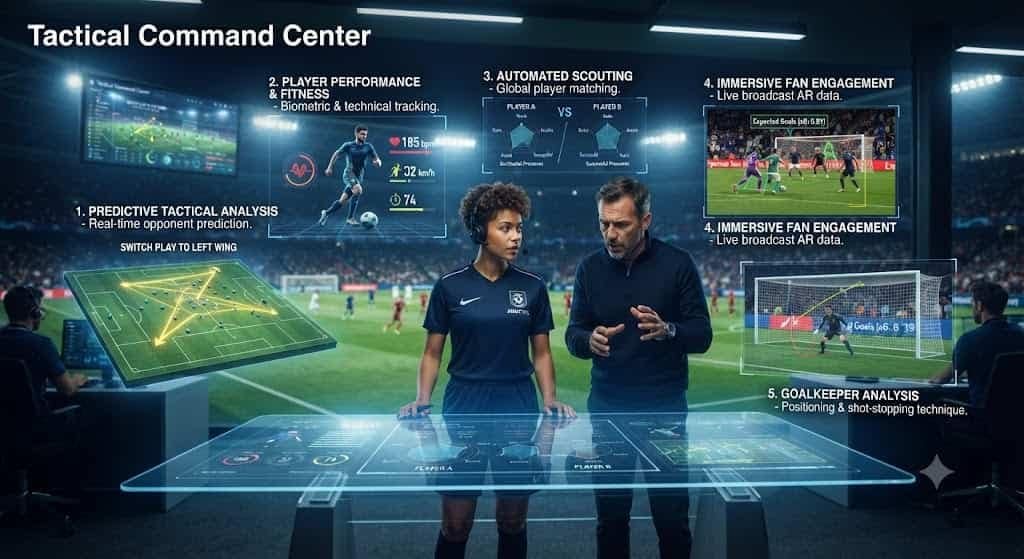
From tactical analysis to match outcome predictions, AI Bola technology is completely transforming football. Explore how machine learning, computer vision, and data science are changing the beautiful game.
Introduction
Football has always been a game of opinions. Pundits argue over “class,” “grit,” and “magic” on the pitch every weekend. But in the boardrooms of Europe’s biggest clubs and the back offices of innovative startups, the conversation has changed. It’s no longer about what the eyes see; it’s about what the data knows.
Welcome to the world of AI Bola.
While “Bola” simply means “ball” in several languages, in the tech space, the term has come to signify the burgeoning field of AI-driven football technology. It encompasses everything from the algorithms that power VAR to the predictive models that help managers decide whether to press high or drop deep.
As tech journalists covering the latest Daily Updates, we’ve watched SaaS platforms and AI tools disrupt industries from finance to healthcare. Now, it’s football’s turn. In this article, we’ll break down how artificial intelligence is being deployed on the pitch, how predictive AI Bola models work, and what this means for the future of the sport.
What is AI Bola Technology?
At its core, AI Bola refers to the application of artificial intelligence—specifically, machine learning and computer vision—to the game of football. It is the digitisation of the sport.
Think of it as a layer of digital intelligence sitting on top of the physical game. This technology processes vast amounts of historical and real-time data to identify patterns that the human brain simply cannot compute.
The Components
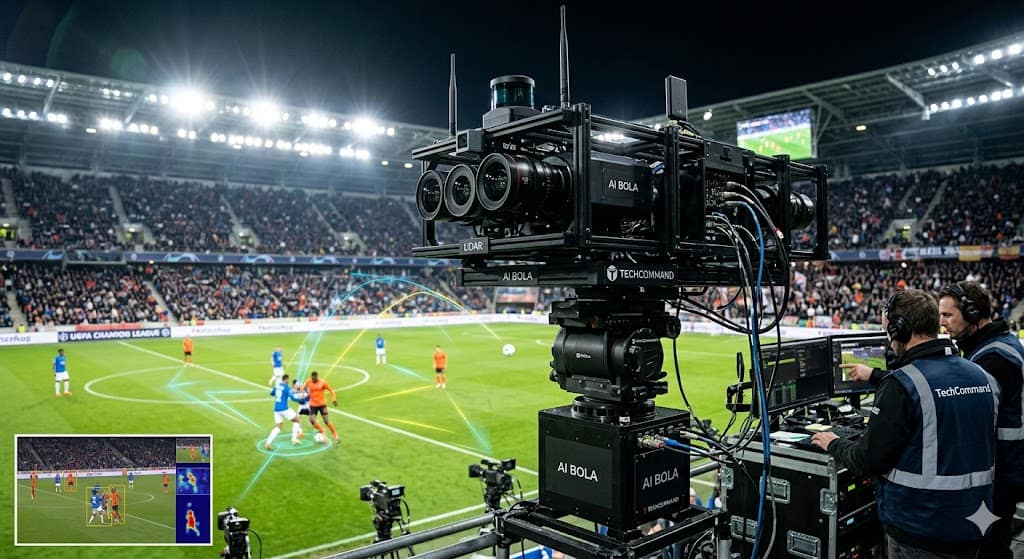
- Computer Vision: Cameras track the x, y, z coordinates of every player and the ball 25 times a second.
- Machine Learning: Algorithms that learn from millions of past matches to predict future outcomes.
- Wearable Tech: GPS trackers in shirts and smart boots measuring physiological data.
This isn’t just about fancy graphics for TV broadcasts; it’s a serious business. Clubs are investing millions in these SaaS platforms to gain a competitive edge.
The Tech Behind the Game: Computer Vision and Tracking
If you’ve ever watched a broadcast and seen a graphic showing a player’s heat map or sprint speed, you’ve seen the output of AI Bola technology.
How It Works
Companies like StatsBomb and Second Spectrum use camera arrays around the stadium to feed video into AI systems. These systems don’t just “record” the game; they “understand” it. They distinguish between players, the ball, the referees, and even the shadows on the pitch.
Why this matters:
- Tactical Analysis: Managers can see exactly how a team’s shape shifts when they lose the ball.
- Recruitment: Instead of watching a player for 90 minutes, scouts can look at data covering 50 games in seconds to assess work rate and passing efficiency.
Key Data Points Captured by AI Bola Systems
| Metric Category | Specific Data Points | Strategic Value |
| Physical | Sprint speed, distance covered, acceleration | Injury prevention, substitution timing |
| Technical | Pass completion rate, xG (Expected Goals), touches | Player valuation, tactical tweaks |
| Tactical | Pitch control (territory), defensive line height | Game strategy, opponent exploitation |
| Physiological | Heart rate, load, fatigue levels | Squad rotation, long-term fitness |
From Pitch to Algorithm: Predictive Analytics in Football
This is the area most people associate with the search term AI Bola—prediction. The idea that a computer can tell you who will win the match.
Image 2: Predictive Modeling Analytics
Markdown

*Caption: Advanced back-office predictive algorithms calculating complex percentage metrics for match outcomes.*
The Science of Prediction
AI models use historical data to calculate probabilities. They feed on:
- Head-to-head records.
- Recent form (last 5-10 games).
- Player availability (injuries/suspensions).
- Home/Away advantage.
- Even weather conditions.
Using complex statistical methods like the Poisson Distribution, these systems generate a probability percentage. For example, the AI might calculate: Team A has a 65% chance of winning, Team B 15%, and a Draw 20%.
Beyond the Scoreline
Predictive AI isn’t just for betting markets (though that is a massive industry). Clubs use it for:
- Title Projections: “How many points do we need to win the league based on current difficulty?”
- Relegation Battles: Calculating the “points per game” needed to survive.
However, it is crucial to note the limitations. AI models struggle with the “human element”—the impact of a new manager, a sudden loss of morale, or a breakout performance from a youth player with no history.
The Business of Sports AI: Scouting and Recruitment
One of the most fascinating applications of AI Bola is in the transfer market. Moneyball came to baseball years ago; it is firmly established in football now.
Finding the Diamond in the Rough
Top-tier clubs use AI to scan lower leagues and obscure global markets for undervalued talent. If a 20-year-old winger in the Brazilian second division has metrics that match the profile of a Premier League star, the AI flags them.
This levels the playing field. Smaller clubs with smaller budgets can use AI productivity software to analyse data and sell their top prospects to bigger clubs for a profit before they’ve even played a full season. For more breakdown on similar enterprise gear, you can check our comprehensive Gadgets & Reviews archive.
Reducing Risk
Transfers are risky. A £50m signing can be a flop. AI reduces this risk by filtering out players whose stats are inflated by a weak league or a lucky season, focusing instead on consistent underlying performance numbers.
AI in Officiating: The VAR Debate
We cannot discuss AI in football without touching on VAR (Video Assistant Referee). While VAR involves human review, the goal-line technology and offside lines are heavily assisted by computer vision systems developed by pioneering bodies like the International Football Association Board.
Image 3: Offside Tracking Accuracy
Markdown

*Caption: Real-time automated offside boundary lines computed via AI Bola vision intelligence tools.*
- Goal-Line Tech: Uses high-speed cameras to determine if the ball crossed the line. It’s instant and 100% accurate.
- Offside Lines: AI tracks the player’s extremities (shoulders, toes) to draw the line.
While fans often complain about the process of VAR, the AI component is generally precise. The controversy usually arises from the subjective rules humans apply to the AI’s data (e.g., was it a “clear and obvious error”?).
Ethical Considerations and Fair Play
As with any sector dealing with cybersecurity trends and data, there are ethical concerns. You can explore how developers tackle global user tracking problems in our dedicated section on Cyber Security & Privacy.
1. Data Privacy
Players’ biometric data is incredibly sensitive. Who owns this data? If a club knows a player has a specific muscular weakness detected by AI, does that lower his transfer value? Governance bodies are currently wrestling with these questions.
2. Gambling Addiction
The accessibility of AI-driven predictions makes gambling easier and “smarter.” However, this poses a risk of addiction. Responsible tech companies must include safeguards, and users must understand that no AI can predict the future with 100% certainty.
3. The “Death of Romance?”
Purists argue that AI kills the spontaneity of the game. If every pass is calculated and every substitution is data-driven, where is the room for the “magic”? The counter-argument is that football at the elite level is already a science; AI just makes the science visible.
AI Bola Tools: What Are the Pros of Using?
If you are a tech enthusiast or a coach looking to get into this space, here are the types of tools driving the industry:
- Tracking Systems: TRACAB, Second Spectrum.
- Analysis Platforms: WyScout, Hudl, StatsBomb.
- Wearables: Catapult Sports, STATSports.
These platforms integrate complex cloud computing tools to process video streams into actionable insights within minutes of the game ending.
Pros and Cons of AI in Football
| Aspect | Pros (The Benefits) | Cons (The Challenges) |
| Performance | Objective analysis, injury prevention | Over-reliance on data, ignoring intuition |
| Scouting | Global reach, cost-effective recruitment | Missing “intangibles” like leadership |
| Officiating | Accuracy in key decisions (GLT, Offside) | Disruption to flow, subjective interpretation |
| Fan Experience | Enhanced stats, engaging visuals | Information overload, “robotic” feel |
The Future of AI Bola
What does the next decade hold?
- Automated Commentary: We are already seeing AI models that can generate real-time match commentary in multiple languages.
- Tactical Simulations: Before a match, managers might run thousands of AI simulations to test their tactics against the opponent’s style.
- AI Referees: Fully automated offsides and fouls are technologically feasible and may be trialled soon.
As digital transformation sweeps through every industry, football proves to be one of the most exciting adopters. The blend of raw human athleticism and cold, hard computation is creating a new era of the sport.
FAQs
What does “AI Bola” mean?
“AI Bola” generally refers to Artificial Intelligence applied to football (soccer). “Bola” means ball in Portuguese and Indonesian, and the term is often used in tech circles to describe AI-driven football analytics, predictions, and tracking systems.
Can AI accurately predict football matches?
AI can predict probabilities with high accuracy based on historical data, but it cannot predict the future with 100% certainty because of the chaotic nature of the sport. It is a tool for estimating likelihood, not guaranteeing results.
How do football clubs use AI?
Clubs use AI for player scouting (analysing performance stats), injury prevention (monitoring physical load), tactical analysis (tracking movement), and to help determine transfer values.
Is VAR run by AI?
Partially. Goal-line technology and offside lines are calculated using AI/computer vision. However, the final decision on fouls and penalties is still made by human referees reviewing the footage.
Is AI used in football betting?
Yes, many betting companies and punters use AI models to calculate odds and find “value” bets. These models process vast amounts of statistical data to spot trends that human oddsmakers might miss.
Final Verdict / Conclusion
Whether you call it AI Bola, Sports Tech, or Football Analytics, the revolution is here. The gap between the data-rich elite clubs and the rest is widening, driven by AI tools that turn every kick, pass, and sprint into actionable intelligence.
For the fans, this means a deeper understanding of the game. For the players, it means higher standards and longer careers. For the clubs, it means the difference between winning trophies and facing relegation.
While we must be mindful of the ethical implications and the need to keep the “human soul” of the game alive, there is no denying that AI is making football smarter, faster, and more competitive than ever before. As we look to the 2026 World Cup and beyond, expect the teams lifting the trophies to be the ones that mastered the code behind the ball.