
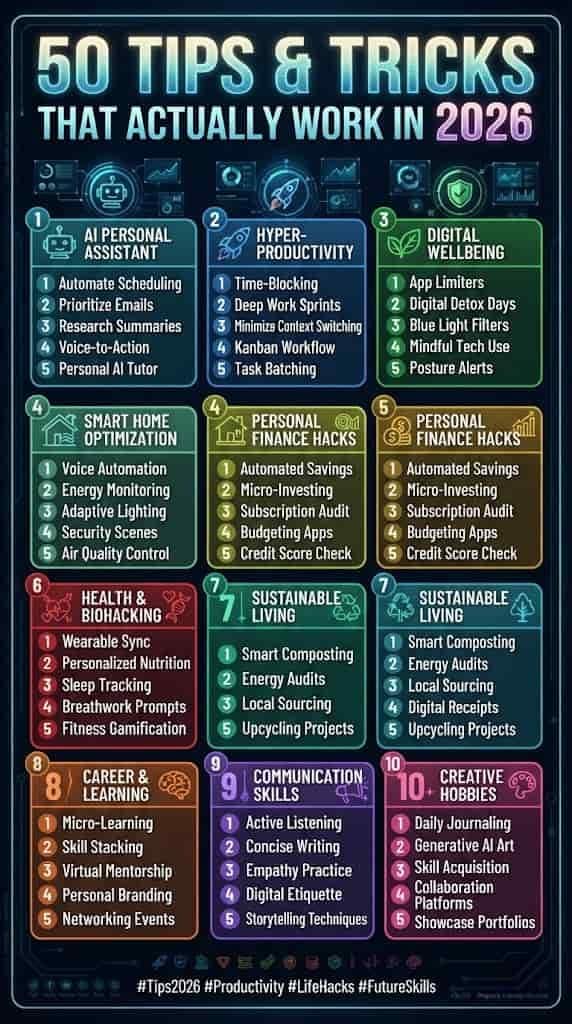
Overwhelmed by advice that doesn’t work? Discover 50 tested tips&tricks for 2026 covering productivity, tech, money, home, and health — no fluff.
50 Tips&Tricks That Actually Work in 2026
You’ve probably tried a dozen “life hack” articles already, bookmarked half of them, and still feel just as stuck, distracted, or behind as before. The problem isn’t a lack of advice — it’s that most tips are generic, outdated, or built for someone else’s life. Below are 50 tips&tricks that actually work in 2026, tested against real routines, current tech, and expert-backed research, organized so you can jump straight to the category you need.
How We Chose These Tips&Tricks
Not every trending hack deserves your time. Each tip below meets three criteria: it’s backed by evidence or expert practice, it works with tools and habits available right now in 2026, and it’s simple enough to start today. That means no 5 a.m. wake-up mandates, no expensive gadgets, and no “just be more disciplined” platitudes.
Search trends around “tips and tricks” show that most people aren’t looking for one silver-bullet hack. They’re looking across several areas of life at once — how to focus better at work, how to use their phone more efficiently, how to stretch a budget, and how to feel physically better day to day. That’s why this guide groups tips by category instead of ranking them 1 through 50. Skim the headings, find the section that matches what’s frustrating you most this week, and start there.
Productivity Tips&Tricks That Actually Work
Productivity advice fails most often because it ignores how individual people actually think and work. These tips focus on systems, not willpower.
Time and Task Management
- Use the “two-minute rule.” If a task takes under two minutes, do it immediately instead of adding it to a list.
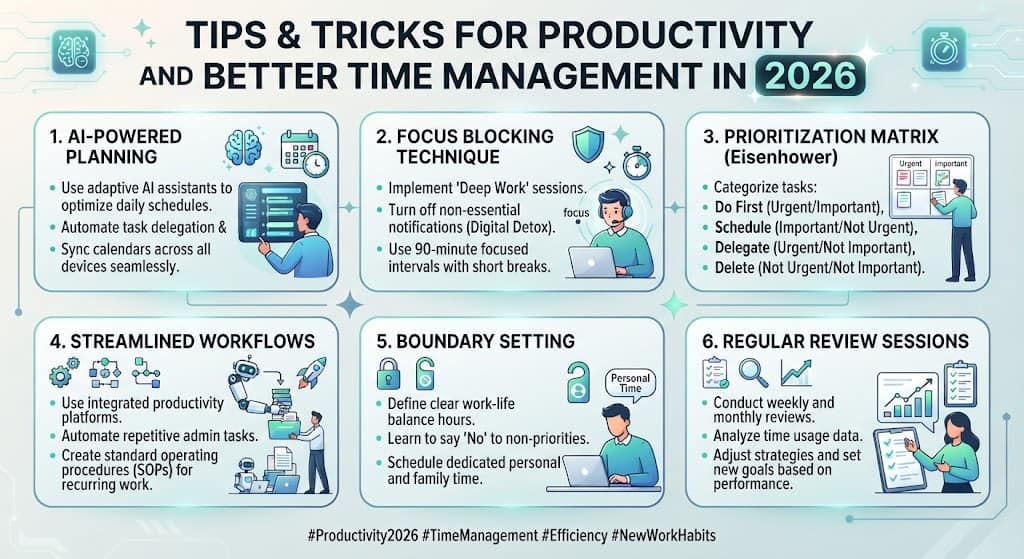
- Time-block your calendar. Assign specific hours to specific tasks rather than relying on an open-ended to-do list.
- Batch similar tasks. Group calls, emails, or errands together to reduce the mental cost of switching between different types of work.
- Protect one deep-work block daily. Even 90 focused minutes without notifications outperforms a scattered eight-hour day.
- Build templates for repeat tasks. Email replies, reports, and meeting agendas don’t need to be rebuilt from scratch each time.
- Apply the “one task rule” each morning. Pick a single task that would make the day feel successful before opening email or chat apps.
- Use the Eisenhower Matrix. Sort tasks into urgent/important quadrants to stop urgent-but-unimportant work from eating your day.
- Set a hard stop time. Close your laptop at a fixed hour to prevent burnout and protect recovery time.
- Try body doubling. Working alongside another person, even virtually, increases follow-through on tasks you tend to avoid.
- Review your week every Friday. A 15-minute weekly review catches loose ends before they become Monday emergencies.
Focus and Attention
- Turn off non-essential notifications. Every alert costs you several minutes of refocusing time, a pattern documented in attention-research summaries from the American Psychological Association.
- Keep your phone in another room during deep work. Visibility alone reduces available cognitive bandwidth, even if the phone stays silent.
- Use single-tab browsing for critical work. Seventeen open tabs isn’t multitasking — it’s fragmented attention.
- Try the Pomodoro Technique. Twenty-five minutes of focused work followed by a five-minute break suits most attention spans.
- Write down intrusive thoughts. A quick capture list clears mental clutter without breaking focus entirely.
Tech Tips&Tricks for 2026
Technology moves fast, and small adjustments to how you use everyday tools save hours every month.
Smartphone and App Tricks
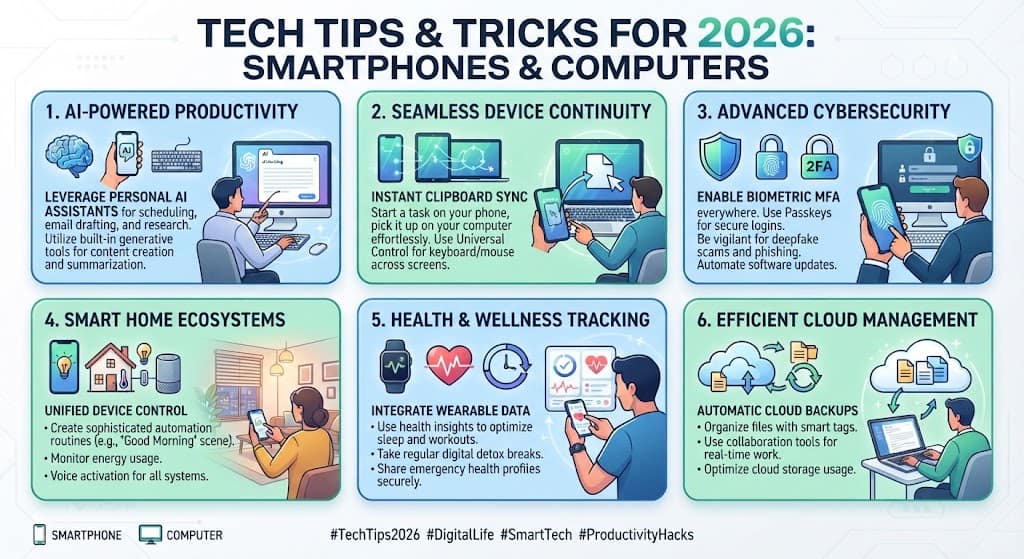
- Set app time limits on your phone. Built-in screen time tools now let you cap distracting apps automatically.
- Use keyboard shortcuts for repetitive tasks. Text expanders can turn a short abbreviation into a full paragraph in seconds.
- Automate routine workflows. No-code automation tools connect apps like email, calendars, and task managers without writing code.
- Enable two-factor authentication everywhere. It remains one of the simplest ways to prevent account takeovers, according to guidance from the Cybersecurity and Infrastructure Security Agency.
- Compress and back up files automatically. Cloud sync tools remove the need to remember manual backups.
- Use AI tools as a first draft, not a final answer. They’re excellent for outlines and research starting points but still need human review for accuracy.
For a deeper breakdown of automation tools worth adopting this year, our guide to workflow automation trends covers what’s actually worth your setup time.
Browser and Computer Tricks
- Use browser profiles to separate work and personal browsing. This reduces distraction and keeps saved passwords organized.
- Clear cache and cookies monthly. It resolves a surprising number of “why is this site broken” issues.
- Learn your operating system’s window-snapping shortcuts. Splitting your screen efficiently saves real time across a workday.
- Set up a password manager. Reusing passwords across sites remains one of the most common causes of account breaches.
Our internal comparison of password manager options breaks down which tools fit different budgets and needs.
Money Tips&Tricks That Actually Work
Financial tips that work in 2026 focus on automation and reducing the number of decisions you have to make manually.
- Automate savings transfers. Move money to savings the day you’re paid, before you can spend it.
- Use the 50/30/20 budgeting rule as a starting point. Fifty percent needs, thirty percent wants, twenty percent savings or debt repayment.
- Audit subscriptions every quarter. Forgotten recurring charges quietly drain hundreds of dollars a year.
- Negotiate recurring bills annually. Internet, insurance, and phone providers often have better rates for existing customers who simply ask.
- Use cashback and rewards strategically. Only if you pay balances in full — rewards points aren’t worth carrying interest-bearing debt.
Home and Life Tips&Tricks
- Adopt the “one-touch” rule for mail and packages. Sort or discard items immediately instead of creating piles.
- Use a “landing zone” near your front door. Keys, wallet, and bag in one spot save minutes of searching daily.
- Batch cook on weekends. Preparing two or three meals in advance reduces weekday decision fatigue around food.
- Label your fridge shelves by expiration urgency. It reduces food waste and helps everyone in the household eat items before they spoil.
- Do a five-minute nightly reset. Clearing counters and surfaces each evening prevents weekend deep-cleaning marathons.
- Keep a repair toolkit accessible. A basic kit prevents small home issues from becoming bigger, costlier ones.
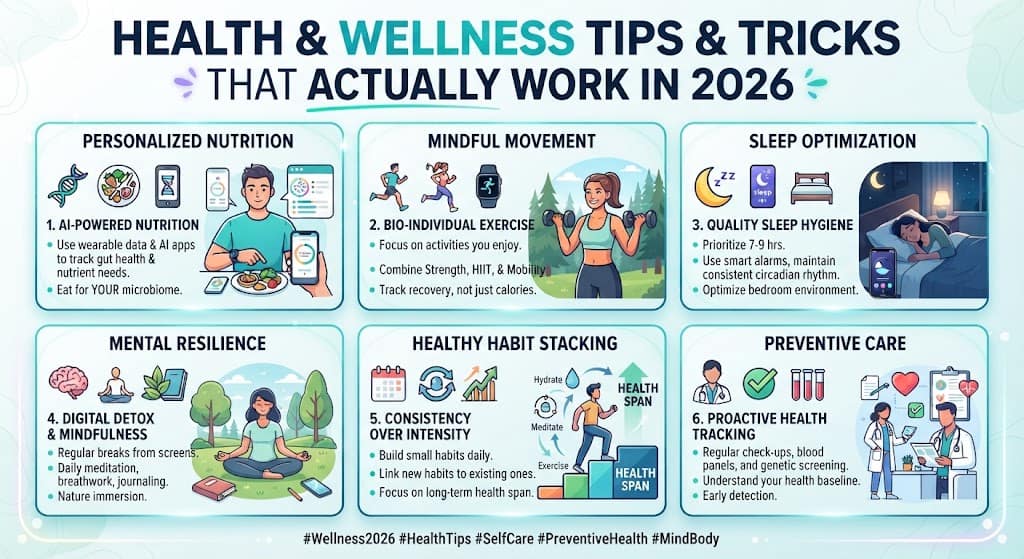
Health and Wellness Tips&Tricks (With Safety Notes)
Wellness advice needs the most scrutiny, since trends move faster than the research behind them. These tips are grounded in established guidance from health authorities.
- Prioritize sleep consistency over sleep duration alone. Going to bed and waking at similar times supports your circadian rhythm more than occasional long lie-ins.
- Get natural light within an hour of waking. Morning light exposure helps regulate your internal clock and mood.
- Move for at least 20–30 minutes daily. Health authorities generally recommend at least 150 minutes of moderate activity per week for most adults.
- Stay hydrated before reaching for caffeine. Mild dehydration is often mistaken for fatigue or brain fog.
- Practice the 20-20-20 rule for eye strain. Every 20 minutes, look at something 20 feet away for 20 seconds.
- Use breathing techniques for acute stress. Slow, extended exhales activate the parasympathetic nervous system and lower heart rate.
- Be cautious with extreme trends like prolonged cold exposure or extended fasting. These can carry real risks for people with heart conditions, low blood pressure, diabetes, or eating disorders.
When to see a doctor: If you experience persistent fatigue, chest pain, unexplained weight changes, ongoing sleep disruption, or symptoms of anxiety or depression that interfere with daily life, these tips are not a substitute for medical care. Speak with a licensed healthcare provider for personalized guidance, especially before starting any new diet, fasting routine, or intense exercise program.
For general population health guidance, resources like the World Health Organization’s physical activity guidelines offer evidence-based benchmarks worth checking against your own routine.
Communication and Relationship Tips&Tricks
- Use “I” statements during disagreements. Framing concerns around your own experience reduces defensiveness in conversations.
- Schedule regular check-ins with close relationships. Consistency matters more than grand gestures for maintaining connection.
- Practice active listening by summarizing before responding. Repeating back what you heard reduces miscommunication significantly.
- Set boundaries clearly and early. Vague boundaries are the most common cause of resentment in both personal and professional relationships.
Learning and Skill-Building Tips&Tricks
- Use spaced repetition for memorization. Reviewing material at increasing intervals improves long-term retention far more than cramming.
- Teach what you learn to someone else. Explaining a concept exposes gaps in your own understanding faster than re-reading notes.
- Track small wins weekly. A simple log of progress builds momentum and makes skill development visible over time.
Comparison: Quick Wins vs. Long-Term Habits
| Category | Quick Win (Try Today) | Long-Term Habit (Build Over Weeks) |
|---|---|---|
| Productivity | Two-minute rule | Weekly review ritual |
| Tech | Enable two-factor authentication | Full workflow automation setup |
| Money | Cancel one unused subscription | Automated savings transfers |
| Health | 20-20-20 eye break | Consistent sleep schedule |
| Relationships | One “I” statement today | Regular check-in schedule |
If you want a deeper dive into building sustainable systems rather than one-off hacks, see our related guide on building better daily systems, which expands on several of the productivity and tech tips above.
Frequently Asked Questions
What are the best tips and tricks for 2026?
The most effective tips combine small, repeatable habits with the right tools — think automated savings, time-blocked calendars, and consistent sleep schedules rather than one-time hacks.
Do productivity hacks actually work?
Some do, especially systems-based approaches like task batching and templates. Advice that ignores individual differences in energy, focus, and schedule tends to fail long-term.
Are extreme wellness trends like cold plunges or extended fasting safe?
Not for everyone. People with cardiovascular conditions, low blood pressure, diabetes, or a history of disordered eating should consult a doctor before trying these trends.
How many of these tips should I try at once?
Start with two or three from different categories. Trying to implement all 50 at once typically leads to abandoning all of them within a week.
What’s the single most impactful tip on this list?
Sleep consistency tends to have the broadest impact, since poor sleep affects focus, mood, decision-making, and physical health simultaneously.
Final Thoughts
The tips&tricks that actually work in 2026 share a common thread: they reduce the number of decisions you need to make and fit into the life you already have, rather than demanding you rebuild it from scratch. Start small — pick two or three tips from the categories that matter most to you right now, whether that’s reclaiming focus, tightening your budget, or protecting your sleep. Track how they feel after two weeks, then add more. And if any wellness change involves your heart, blood sugar, mental health, or existing medical conditions, check with a healthcare professional before making it part of your routine. Small, sustainable changes — applied consistently — are what actually move the needle this year.
