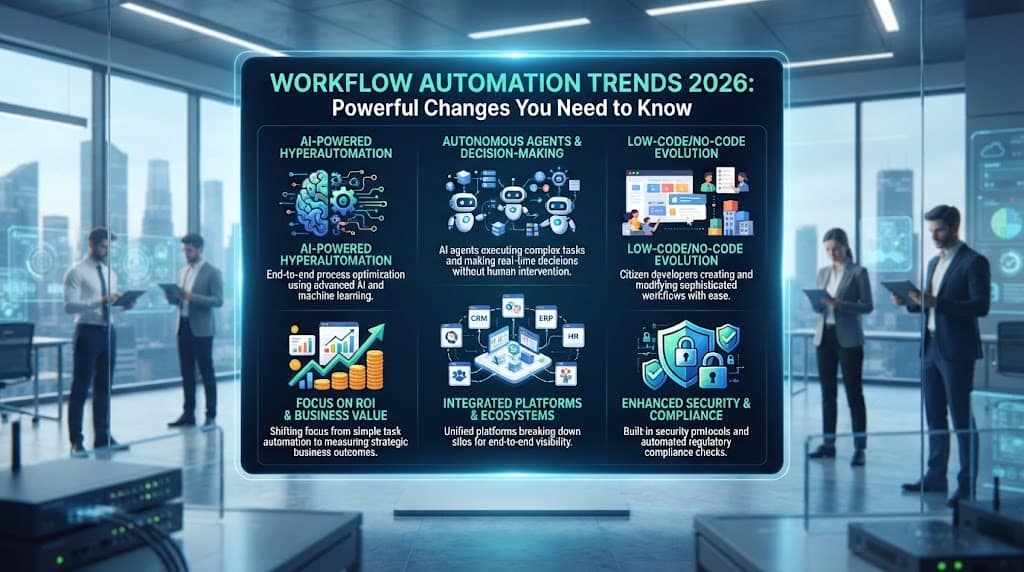
Discover the workflow automation trends shaping 2026 — agentic AI, hyperautomation, low-code platforms, AI-powered process mining, and governance — plus how to decide which trends are actually worth adopting.
Quick Answer
The biggest workflow automation trends in 2026 are agentic AI, hyperautomation, low-code/no-code platforms, AI-powered process mining, and a growing emphasis on governance and human-in-the-loop oversight as automation takes on more decision-making responsibility.
The organizations getting the most value aren’t adopting every trend at once. They’re starting with a single high-volume, well-understood process, proving measurable ROI, building appropriate controls, and scaling from there.
Why Workflow Automation Looks Different in 2026
For most of the last decade, “workflow automation” meant one thing: if-this-then-that rules that handled repetitive, predictable tasks — routing an approval, updating a record, sending a notification. That version of automation still exists and still works, but it’s no longer where the most significant change is happening.
In 2026, the shift is from automation that simply follows instructions to automation that can evaluate context and make decisions within defined boundaries. AI-driven systems are increasingly capable of adapting actions in real time and handling work that previously required human judgment.
This changes how businesses should think about which processes to automate, what skills their teams need, and how much oversight is required when software starts making decisions that used to sit with a person.
McKinsey’s research similarly points toward workflow redesign as an important part of capturing AI’s productivity potential: applying AI to isolated tasks within legacy processes is less likely to deliver the full benefit than redesigning the broader workflow around people, agents, and automation.
This guide breaks down what’s actually driving workflow automation trends this year, what’s genuinely new versus repackaged, and how to evaluate which trends are worth acting on for your organization.
The Core Workflow Automation Trends Shaping 2026
1. Agentic AI Takes on Multi-Step Work
The most significant shift in workflow automation is the move toward agentic AI — AI agents capable of analyzing context, making recommendations, and completing defined workflow tasks with limited human input.
Instead of a single automation triggering a single action, an agent can work through a sequence of decisions: gathering information, evaluating options, selecting a next step, and escalating when necessary.
That makes agentic automation fundamentally different from traditional rule-based automation.
UiPath’s current documentation describes agents as probabilistic and adaptive systems suited to unstructured or exception-heavy tasks, while traditional RPA robots remain deterministic and rule-based. It also describes agentic automation as an orchestration of agents, robots, and humans rather than a replacement for conventional automation.
This matters for workflow design because it shifts the human role from operator to supervisor.
Rather than configuring every possible branch of a decision tree in advance, teams can increasingly define goals, permissions, escalation rules, and guardrails while reviewing the output of the automated system.
Microsoft is following a similar direction, offering no-code, low-code, and pro-code approaches for building and orchestrating agents across its ecosystem.
The practical takeaway is simple: agentic AI is most valuable when a process involves multiple steps, changing context, or judgment-like decisions. It doesn’t make sense to replace a simple deterministic workflow with an autonomous agent just because the technology is available.
Hyperautomation Moves From Buzzword to Standard Practice
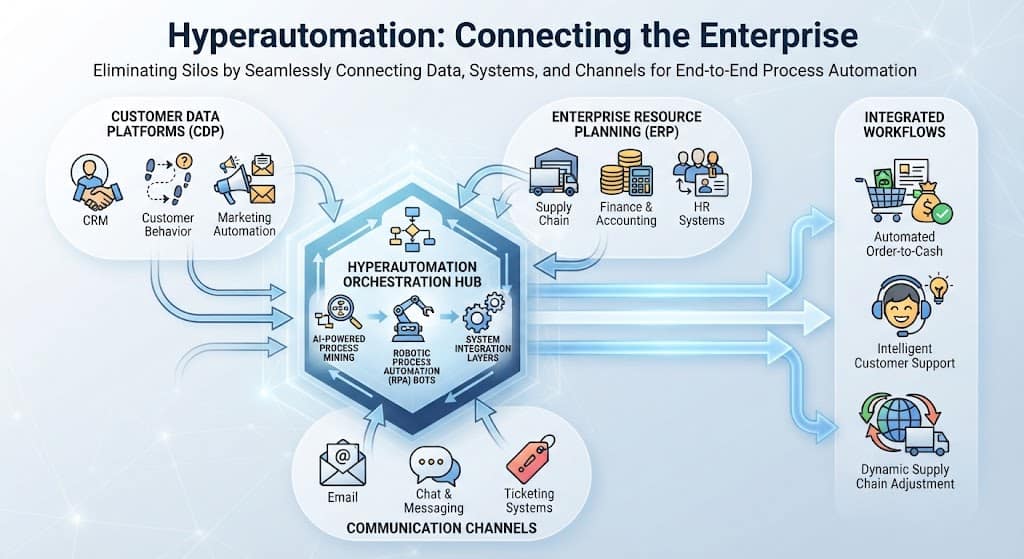
Hyperautomation refers to combining AI, robotic process automation (RPA), process intelligence, and system integrations to automate entire end-to-end processes rather than isolated tasks.
The distinction matters.
Automating one step in a five-step process — such as data entry — still leaves four manual handoffs. Hyperautomation aims to connect the whole chain so that a process involving multiple tools, teams, and manual check-ins can operate with far less friction.
This trend is closely tied to cross-system orchestration: coordinating actions across an organization’s CRM, ERP, ticketing systems, communication tools, databases, and other business applications instead of treating each platform as its own automation silo.
A useful way to think about the progression is:
Traditional automation → RPA → integrated automation → hyperautomation → agentic orchestration
The technologies overlap rather than replace one another.
RPA remains particularly useful when organizations need to automate repetitive interactions with legacy applications that lack modern APIs. AI can then be layered on top when the workflow needs contextual interpretation or decision-making.
3. Low-Code and No-Code Platforms Reduce Developer Dependency
A growing share of workflow automation is being built and modified by business users rather than developers.
Low-code and no-code platforms reduce the bottleneck of waiting for IT or engineering resources for every workflow change. That is helping automation move beyond large enterprises into smaller organizations and individual business teams.
Some platforms are also adding natural-language interfaces that let users describe desired workflows instead of manually configuring every component.
This doesn’t mean developers become irrelevant. Complex integrations, security controls, custom applications, data architecture, and enterprise governance still require technical expertise.
Instead, the role of developers increasingly shifts toward building the foundations and guardrails that allow business teams to safely automate routine processes themselves.
Microsoft’s current agent tooling illustrates this broader convergence: users can create agents through no-code experiences, customize them through low-code tools, or build more deeply integrated solutions with pro-code tooling.
4. AI-Powered Process Mining Finds Inefficiencies Automatically
Process mining tools analyze system logs and data trails to map how a process actually operates in practice rather than how it is documented to operate.
Increasingly, AI is being used to identify:
- Bottlenecks
- Repeated manual steps
- Unnecessary approvals
- Process deviations
- Exception patterns
- Automation opportunities
This is an important change because it turns “where should we automate first?” from a subjective workshop exercise into a question that can be informed by actual process data.
It also helps organizations avoid one of the biggest automation mistakes: automating the wrong process.
If a process is already inefficient, simply automating it can make a bad process run faster without making it better.
The combination of process mining and automation therefore creates a more logical sequence:
Observe → analyze → redesign → automate → measure → improve
Governance, Compliance, and Human-in-the-Loop Oversight Become Central
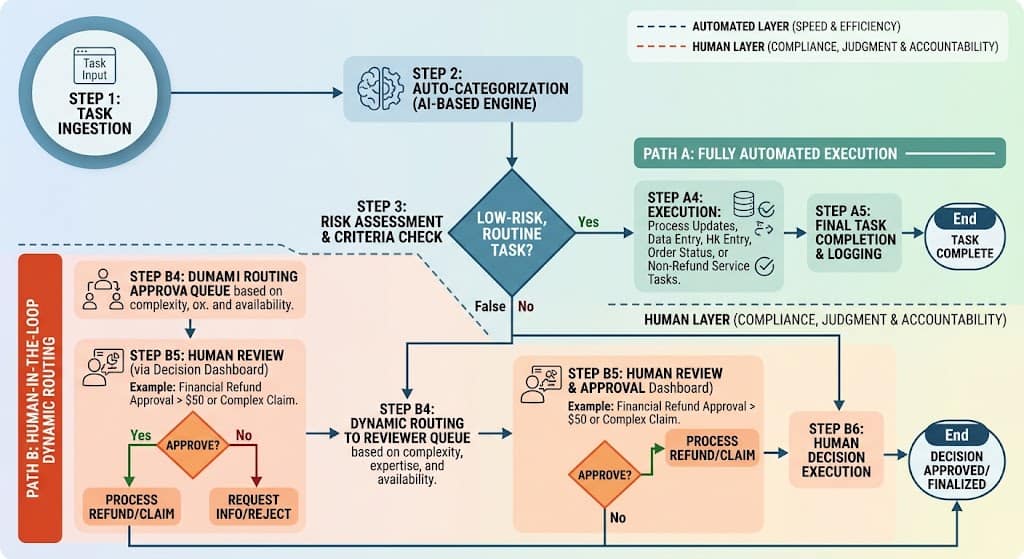
As automation takes on more decision-making responsibility, governance is becoming a first-class design requirement rather than an afterthought.
This is especially important when automated workflows affect financial transactions, customers, employees, healthcare decisions, or regulatory compliance.
There are several practical components to this shift:
- Audit-ready record-keeping: Automated workflows increasingly generate records of actions, decisions, and approvals as they operate.
- Regulatory workflow automation: Systems can flag risk, route exceptions, and maintain audit trails automatically.
- Human-in-the-loop checkpoints: Higher-risk decisions can be routed to a person before an action becomes final.
- Access controls: Agents and automations need clearly defined permissions so they cannot perform actions outside their intended scope.
- Monitoring: Organizations need visibility into what automated systems are doing and where exceptions are occurring.
For additional reading, see TechCommand’s AI governance and contextual accuracy guide, which explores governance, contextual accuracy, risk controls, and enterprise AI oversight.
This isn’t a rejection of automation. It’s recognition that as automation becomes more capable, the cost of an unreviewed mistake also increases.
The principle is straightforward:
More autonomy requires stronger controls.
6. Industry-Specific Workflow Automation Deepens
Rather than relying entirely on generic, one-size-fits-all automation platforms, more organizations are configuring automation around the workflows and regulatory requirements of individual industries.
Examples include:
- Healthcare: Clinical documentation, prior authorization, patient administration, EHR-related workflows, and compliance processes
- Finance: Fraud detection, regulatory reporting, risk management, audit preparation, and transaction monitoring
- IT: Incident management, testing, deployment, infrastructure monitoring, and self-healing operations
- Manufacturing: Production scheduling, quality management, maintenance, and supply-chain coordination
- Logistics: Order processing, inventory management, routing, and exception handling
Industry-specific automation can embed compliance requirements and domain logic directly into workflows rather than requiring every organization to build those controls from scratch.
McKinsey’s research also indicates that a substantial share of potential AI productivity gains is concentrated in sector-specific workflows, including supply chain in manufacturing, clinical and patient-care workflows in healthcare, and regulatory compliance and risk management in finance.
7. Real-Time Data and Adaptive Workflows Replace Static Processes
Traditional workflows often operate according to fixed schedules or predetermined rules.
Modern workflows increasingly react to live data.
For example, a customer-experience workflow might change its next action based on a customer’s latest behavior across multiple channels instead of sending every customer through the same predetermined sequence.
The same principle applies to IT operations, fraud detection, supply chains, marketing, and financial workflows.
The underlying change is from:
“Run this workflow every Monday at 9 AM.”
to:
“When the relevant conditions change, determine the appropriate next action.”
That makes real-time data, event-driven architecture, APIs, and AI-powered decision layers increasingly important components of modern automation.
How Big Is the Workflow Automation Market Right Now?
Workflow automation has moved from an early-adopter technology toward a mainstream business investment.
Mordor Intelligence estimates that the global workflow automation market was worth $23.77 billion in 2025 and will grow from $26.01 billion in 2026 to $40.77 billion by 2031, representing a projected 9.41% CAGR. The research also identifies Asia-Pacific as the fastest-growing regional market and North America as the largest.
The same research reports that banking and financial services accounted for 23.62% of the market in 2025, while healthcare and pharmaceuticals are projected to grow at an 11.22% CAGR through 2031. It also reports that cloud accounted for 62.15% of deployment revenue in 2025, while hybrid deployments are projected to grow at 10.08% annually through 2031.
The numbers should be treated as market-research estimates rather than universal accounting figures because different research firms define “workflow automation” differently.
What is clearer is the direction: automation is expanding from isolated RPA deployments toward broader combinations of orchestration, process mining, AI, integrations, and agentic capabilities.
Comparison Table: Workflow Automation Approaches
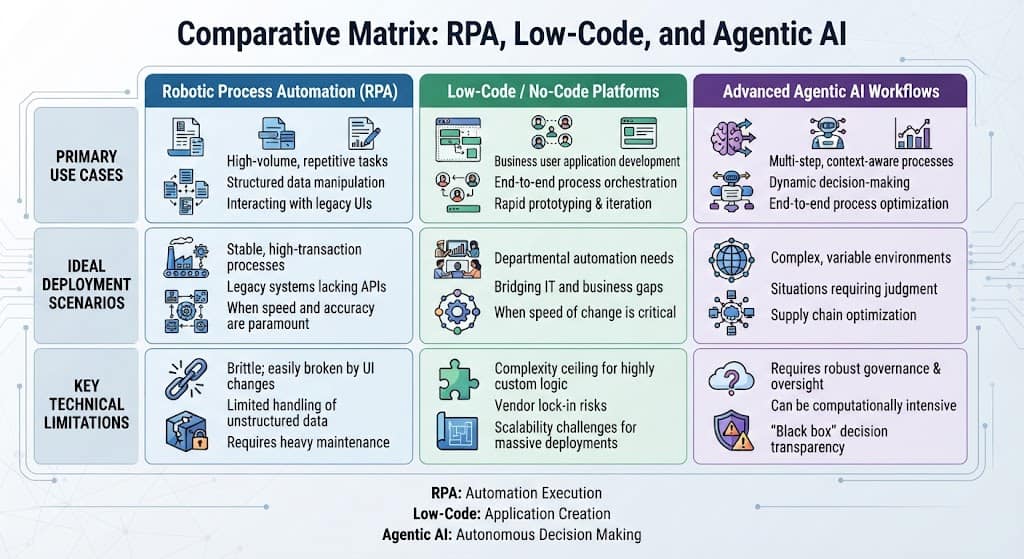
| Approach | Best For | Requires Developer Resources? | Key Limitation |
|---|---|---|---|
| Traditional rule-based automation (if-this-then-that) | Simple, highly predictable, repetitive tasks | Sometimes | Breaks down when exceptions or context changes are common |
| Robotic Process Automation (RPA) | Repetitive tasks across legacy systems without APIs | Moderate | Brittle when the underlying interface or system changes |
| Low-code/no-code platforms | Business teams building or adjusting workflows independently | Minimal | Can hit complexity ceilings for highly custom logic |
| Hyperautomation (AI + RPA + integrations) | End-to-end processes spanning multiple systems and teams | High initially | Requires more upfront process mapping and governance |
| Agentic AI | Multi-step tasks requiring context evaluation and judgment-like decisions | Varies by platform | Needs clear guardrails and human review points to manage risk |
RPA remains relevant because it solves a different problem from agentic AI. Traditional robots excel at deterministic, repetitive execution, while agents are better suited to dynamic, context-dependent work. Modern enterprise automation increasingly combines both rather than choosing one over the other.
Practical Examples: What These Trends Look Like in Practice
- Finance team: A regulatory compliance workflow automatically flags transactions that meet specific risk criteria, generates an audit-ready record of the decision logic, and routes only the flagged exceptions to a human reviewer — instead of requiring manual review of every transaction.
- IT operations: A self-healing system detects a recurring server issue, triggers a predefined fix automatically, and only escalates to a human engineer if the automated fix doesn’t resolve the problem — reducing the volume of routine incident tickets reaching the team.
- Customer support: An agentic AI workflow reads an incoming support request, checks account history and relevant documentation, drafts a response, and either sends it automatically for low-risk requests or routes it to a human agent for approval on anything involving a refund or account change.
- HR onboarding: A hyperautomated onboarding process connects the HR system, IT provisioning, payroll, and building access systems so that a single “new hire approved” trigger cascades through every downstream system, instead of requiring five separate manual steps across different departments.
- Marketing operations: A process mining tool analyzes how content actually moves from draft to publication across a marketing team’s tools, identifies that approval requests sit unaddressed for an average of several days, and flags that stage as the highest-value target for automation — rather than the team guessing where the bottleneck is.
Practical Examples: What These Trends Look Like in Practice
A regulatory compliance workflow automatically flags transactions that meet defined risk criteria, creates an audit-ready record, and routes only flagged exceptions to a human reviewer.
Generative AI can also assist finance teams with time-consuming information tasks, although accuracy and governance remain critical because financial workflows often involve sensitive data and consequential decisions.
IT Operations
A self-healing system detects a recurring server issue, triggers a predefined remediation step, and escalates to a human engineer if the automated fix fails.
This reduces the number of routine incidents reaching engineers while keeping humans responsible for more complex failures.
Customer Support
An agentic AI workflow reads an incoming support request, checks account history and relevant documentation, drafts a response, and either handles a low-risk request automatically or routes a refund or account-change request to a human agent.
This illustrates the value of combining AI with clear escalation rules rather than attempting to automate every customer decision.
HR Onboarding
A hyperautomated onboarding process connects the HR system, IT provisioning, payroll, and building-access systems.
A single “new hire approved” trigger can cascade through downstream systems instead of requiring several manual steps across different departments.
Marketing Operations
A process-mining system analyzes how content moves from draft to publication, identifies that approval requests remain unaddressed for several days, and flags that stage as the highest-value target for automation.
This is a good example of using process intelligence before automation rather than simply automating the first task that looks repetitive.
Pros and Cons of Modern Workflow Automation Trends
Pros
- Reduces time spent on repetitive, low-judgment tasks, freeing employees for higher-value work
- Improves consistency and reduces manual error in high-volume processes
- Creates automatic audit trails that simplify compliance and reporting
- Low-code platforms make automation accessible to teams without dedicated developer resources
- Real-time, adaptive workflows respond to changing conditions instead of running on rigid, outdated logic
Cons
- More autonomous automation (especially agentic AI) requires new governance and oversight structures that many organizations haven’t built yet
- Hyperautomation projects require significant upfront process mapping and cross-system integration work
- Automating a poorly understood or inefficient process can simply make a bad process run faster, not better
- The skills needed to design and manage modern automation (AI, integration, governance) are in short supply relative to demand
- Over-automating customer-facing or high-stakes decisions without adequate human review can create real business and compliance risk
Will Workflow Automation Replace Jobs?
This is one of the most common questions surrounding these trends, and the honest answer is more nuanced than a simple yes or no. Automation does eliminate certain narrowly task-based roles — particularly repetitive, rule-based work that doesn’t require judgment. At the same time, it’s creating demand for roles that didn’t meaningfully exist a few years ago: people who design, manage, and improve automated systems, oversee AI agent behavior, and handle the governance and compliance side of increasingly autonomous workflows. The net effect for most organizations isn’t a simple reduction in headcount — it’s a shift in what kind of work people are doing, with more emphasis on oversight, exception-handling, and system design than on manual task execution.

Final Verdict
Workflow automation in 2026 isn’t defined by a single new tool.
It’s defined by a shift in what automation is trusted to do.
The move from rigid, rule-based automation toward context-aware and adaptive systems — including agentic AI, hyperautomation, and AI-powered process mining — creates new opportunities for efficiency and scale.
But it also raises the stakes around governance, accuracy, security, and accountability.
The organizations most likely to succeed are not necessarily the ones adopting the most advanced technology first.
They are the ones that:
- Start with a well-understood, high-volume process.
- Map how the process actually works.
- Choose the simplest automation technology that solves the problem.
- Build human oversight into higher-risk decisions.
- Measure ROI.
- Scale only after the first implementation proves its value.
The technology has genuinely changed.
The discipline required to adopt it well hasn’t.
FAQs
What are the biggest workflow automation trends in 2026?
The most significant trends are agentic AI, hyperautomation, low-code/no-code platforms, AI-powered process mining, real-time adaptive workflows, and stronger governance and human-in-the-loop oversight.
What is agentic AI in workflow automation?
Agentic AI refers to AI systems that can analyze context, evaluate options, and complete multi-step workflow tasks with limited human input.
Unlike traditional rule-based automation, agentic systems can adapt their actions based on the information they encounter. However, higher autonomy also requires stronger guardrails and oversight.
What is hyperautomation, and how is it different from regular automation?
Hyperautomation combines technologies such as AI, RPA, process intelligence, and system integrations to automate broader end-to-end processes rather than a single isolated task.
Is RPA still relevant with newer AI-driven automation available?
Yes.
RPA remains well suited to repetitive, structured tasks, particularly when working with legacy systems that lack accessible APIs. Modern automation strategies often combine RPA with AI and integrations instead of replacing RPA completely.
Will workflow automation eliminate jobs?
Automation is likely to eliminate some repetitive task-based work while increasing demand for roles focused on designing, managing, monitoring, and governing automated systems.
The larger change is likely to be a shift in the type of work people perform, rather than a simple one-for-one replacement of employees by software.
What industries are adopting workflow automation the fastest?
Finance, healthcare and pharmaceuticals, technology and IT operations, manufacturing, and logistics are among the important areas for workflow automation because they contain large numbers of repetitive, data-intensive, or compliance-sensitive processes.
Do I need agentic AI to benefit from workflow automation?
No.
Many organizations can achieve significant value from simple rule-based automation, workflow platforms, or RPA.
Agentic AI is most useful when a process genuinely requires context evaluation, unstructured information handling, or judgment-like decisions.
How should a business decide which process to automate first?
Start with a high-volume, rule-heavy process where the current manual workflow is well understood.
Map how it actually operates, identify bottlenecks and exceptions, select the simplest technology that solves the problem, and prove measurable ROI before expanding to more complex workflows.
What skills are needed to work in workflow automation today?
Modern automation teams increasingly need a combination of AI literacy, RPA experience, process mapping, systems integration, data skills, security knowledge, and governance or compliance awareness.
How big is the workflow automation market in 2026?
Mordor Intelligence estimates the global workflow automation market at $26.01 billion in 2026, growing to $40.77 billion by 2031 at a projected CAGR of 9.41%. Because market-research firms use different definitions and methodologies, individual market-size estimates can vary.
What is the economic impact of AI-powered automation?
McKinsey estimates that generative AI could potentially create $2.6 trillion to $4.4 trillion in annual economic value across 63 use cases, with particularly significant potential in customer operations, marketing and sales, software engineering, and R&D.mation today?
Increasingly, a combination of AI literacy, RPA experience, systems integration knowledge, and compliance or governance awareness — a broader skill set than the purely technical rule-configuration skills that earlier automation relied on.