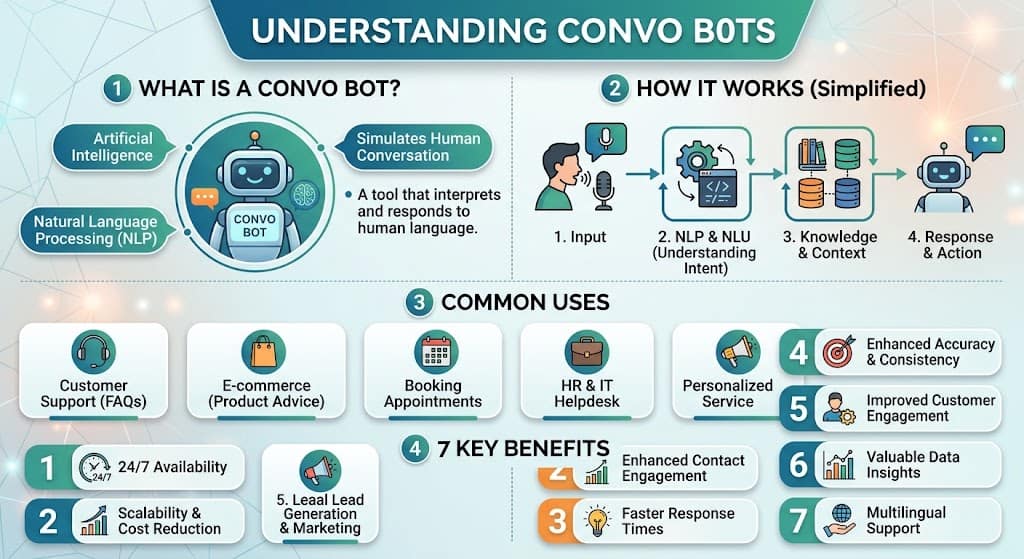
Most people still use the word “chatbot” for almost any chat widget on a website. But modern conversational AI has moved well beyond simple scripted replies. A convo bot is designed to understand natural language, maintain conversation context, and provide more flexible responses based on what a user is trying to accomplish.
If you have ever asked a support chatbot a simple question and received an unhelpful “I didn’t understand that” message, you have experienced the limitations of traditional rule-based automation.
A modern convo bot aims to reduce those problems by combining natural language processing (NLP), conversation management, AI-generated or pre-approved responses, and business-system integrations.
In this guide, you’ll learn what a convo bot is, how it works, how it differs from a traditional chatbot, where businesses use it, its key benefits, and what to check before choosing one.
What Is a Convo Bot?
A convo bot is a conversational AI tool designed to interact with users through natural, multi-step conversations. It can use natural language processing (NLP), machine learning, and in many cases large language models (LLMs) to understand the meaning behind a user’s message rather than relying only on exact keyword matches.
Traditional chatbots often depend on predefined rules or decision trees. If a user enters wording that does not match the expected options, the conversation may stop or return an irrelevant response.
A convo bot can generally handle more flexible interactions.
It may be able to:
- Understand different ways of asking the same question
- Maintain context across several messages
- Identify important details such as dates, order numbers, or product names
- Adjust its tone according to the conversation
- Recognize when a conversation needs human assistance
- Connect with business systems to retrieve information or perform supported actions
The main goal is not simply to make a chatbot sound more human. It is to make automated conversations more useful, context-aware, and capable of handling natural variations in user requests.
How Does a Convo Bot Work?
A convo bot is usually built from several connected components rather than one single technology. The exact architecture varies between platforms, but four common layers are involved.
1. Natural Language Understanding (NLU)
Natural Language Understanding helps the system interpret what the user means.
Instead of looking only for a specific keyword, the system can identify:
- User intent
- Important entities and details
- The context of a request
- Sometimes sentiment or signs of frustration
For example, “Where is my package?” and “I still haven’t received my order” can represent the same basic intent even though the wording is different.
2. Dialogue Management
Dialogue management keeps track of the conversation state.
It helps the system understand what has already been discussed, what information is still missing, and what should happen next.
For example, if a customer provides an order number earlier in the conversation, a context-aware system may be able to use that information later instead of asking for it repeatedly.
3. Response Generation
The response layer determines what the bot should say.
Depending on the platform, responses may come from:
- Pre-approved content
- Rules and templates
- An AI or LLM
- A combination of these approaches
Hybrid systems can give businesses more flexibility while maintaining greater control over important responses.
4. System Integration
Integrations allow a convo bot to interact with business software.
Depending on the platform and permissions, it may connect with:
- CRM systems
- Helpdesk platforms
- Order databases
- Booking systems
- Knowledge bases
- E-commerce platforms
Without useful integrations, a bot may be able to answer questions but have limited ability to complete real tasks.
Convo Bot vs Traditional Chatbot
Although the terms are sometimes used interchangeably, there can be meaningful differences between a basic rule-based chatbot and a more conversational AI system.
| Feature | Traditional Chatbot | Convo Bot |
|---|---|---|
| Logic | Fixed rules and decision trees | NLP/AI-driven conversation |
| Context | None or limited | Can retain conversation context |
| Language variation | Often limited | Better suited to natural variations |
| Responses | Usually scripted | Scripted, AI-generated, or hybrid |
| Setup | Manual flow-building | Data, configuration, and integrations |
| Human escalation | Basic or predefined | Can use context and conversation signals |
| Tone | Usually fixed | Can be customized |
| Best suited for | Simple predictable queries | Support, sales, booking, and multi-step interactions |
The distinction is not absolute. Some traditional chatbots include NLP, while some modern conversational systems still rely heavily on rules. The biggest practical difference is usually how well the system handles context, language variation, and complex conversations.
For more information about improving chatbot communication, see TechCommand’s guide on how chatbot responses are structured for better user experience.
Where Are Convo Bots Used?
Convo bots can be used in many situations where businesses need to communicate with users repeatedly or provide assistance at scale.
Customer Support
Customer support is one of the most common applications.
A convo bot can help with:
- Frequently asked questions
- Order tracking
- Return information
- Basic troubleshooting
- Account-related questions
- Routing complex issues to human agents
The goal is to resolve routine requests quickly while giving users a clear path to human assistance when automation is not appropriate.
E-Commerce Shopping Assistance
Online stores can use conversational AI to help shoppers find suitable products.
Instead of making users search through multiple categories, a bot can ask questions such as:
- What is your budget?
- What type of product are you looking for?
- Who is the product for?
- Which features matter most to you?
It can then use the answers to guide the customer toward relevant options.
Internal Helpdesks
Businesses can also use convo bots internally.
Common applications include:
- HR questions
- IT support
- Employee onboarding
- Internal documentation
- Company policy information
This can reduce the number of repetitive questions handled manually by internal support teams.
Appointment Booking and Scheduling
Convo bots can help users schedule appointments, check available options, and receive reminders.
In sensitive industries such as healthcare, however, organizations need to consider privacy, security, regulatory requirements, and appropriate human oversight before deploying conversational AI.
Lead Qualification
A conversational system can replace or supplement a static lead form.
Instead of asking visitors to complete a long form, a bot can collect qualifying information through a short conversation and route higher-intent prospects to the appropriate sales team.
7 Key Benefits of Convo Bots
Businesses are adopting conversational AI for several practical reasons.
1. Faster Responses
A convo bot can respond immediately to routine questions rather than requiring customers to wait for an available support representative.
2. 24/7 Availability
Automated systems can operate outside normal business hours, making them useful for businesses serving customers across different time zones.
3. More Flexible Conversations
Natural-language systems can handle different ways of expressing the same request instead of requiring users to select a specific scripted option.
4. Lower Support Workload
When routine questions are handled automatically, human agents can spend more time on complex, sensitive, or high-value conversations.
5. Consistent Information
A properly configured system can provide consistent answers based on approved business information and knowledge sources.
6. Better Customer Insights
Conversation data can reveal recurring questions, common problems, and areas where a website, product page, or help center could be improved.
7. Business-System Integration
When connected to the right systems, a convo bot can do more than provide information. It may be able to retrieve account information, check orders, schedule appointments, or initiate supported workflows.
The actual benefits vary depending on the quality of the underlying data, integrations, implementation, and human oversight.
Common Misconceptions About Convo Bots
“A convo bot is just a chatbot with a new name.”
Not necessarily. The term “convo bot” is generally used for systems designed around more natural and context-aware conversations. However, there is significant overlap between chatbot and conversational AI technologies.
Some chatbots use NLP, while some conversational systems still use rules and predefined responses.
“A convo bot will replace human customer support.”
Most practical deployments are designed to assist human teams rather than eliminate them.
Automated systems are particularly useful for repetitive requests, while human agents remain important for complex, sensitive, unusual, or high-value situations.
“A convo bot works perfectly without training.”
A conversational system still needs accurate information.
Businesses may need to provide product documentation, FAQs, policies, knowledge-base content, and other trusted information. Performance should also be monitored and improved over time.
“All convo bots use the same technology.”
They do not.
Some systems rely mainly on rules and traditional NLP techniques, while others use LLMs, retrieval-augmented generation (RAG), proprietary models, or hybrid architectures.
The right approach depends on the organization’s requirements, budget, data sensitivity, integrations, and desired level of automation.
What Should You Check Before Choosing a Convo Bot?
A good demonstration does not necessarily mean a platform will perform well with real customers.
Before choosing a solution, evaluate the following:
- Context retention: Can it remember relevant information during a conversation?
- Fallback handling: What does it do when it does not know the answer?
- Human handoff: Can users reach a human agent when necessary?
- Integration: Can it connect with your CRM, helpdesk, website, or other systems?
- Training flexibility: Can you provide your own business information?
- Analytics: Can you see what users are asking?
- Security and privacy: How is conversation data stored and processed?
- Tone control: Can responses be adapted to your brand voice?
- Accuracy: Does it provide reliable answers using trusted sources?
- Testing: Can you test it with realistic user conversations before deployment?
One of the best ways to evaluate a convo bot is to test it with messy, incomplete, and naturally worded questions rather than only the polished examples shown in a product demonstration.
FAQs About Convo Bots
What is the difference between a convo bot and a regular chatbot?
A basic chatbot may depend heavily on predefined rules and decision trees. A convo bot generally focuses more on natural language, conversation context, and flexible interactions. The exact difference depends on the technology used by the particular platform.
Do convo bots use ChatGPT or similar AI models?
Some do. Many modern conversational systems use large language models or similar AI technologies, while others use proprietary models, traditional NLP, rules, or hybrid architectures.
Can a convo bot replace a customer support team?
Usually, it should be viewed as a support tool rather than a complete replacement for human agents. Convo bots can handle routine questions, while humans can manage complex, sensitive, or unusual cases.
Is a convo bot expensive to set up?
Costs vary considerably. A small business may use an existing conversational AI platform, while a larger organization may require custom development, integrations, security controls, and ongoing maintenance.
How long does it take to train a convo bot?
There is no universal timeline. The process depends on the amount and quality of available business data, integrations, testing requirements, and the complexity of the intended use cases. Improvement is normally an ongoing process rather than a one-time training event.
Can a convo bot work without an internet connection?
Some conversational systems can operate in private or controlled environments, but the answer depends on the specific platform, model, infrastructure, and integrations being used.
Are convo bots safe for customer data?
Safety depends on how the system is designed and managed. Businesses should evaluate data storage, access controls, encryption, privacy requirements, vendor policies, and regulatory obligations before processing sensitive information.
The Future of Convo Bots
Conversational AI is moving beyond simple text-based customer support.
Future systems are likely to combine multiple forms of interaction, including:
- Text
- Voice
- Images
- Documents
- Business data
- Automated workflows
Multimodal systems could allow a customer to upload an image, ask a question about it, and continue the conversation through voice or text.
Personalization is another important direction. With appropriate permissions and privacy controls, conversational systems can potentially use relevant customer history and preferences to provide more contextual assistance.
At the same time, businesses will need to pay greater attention to privacy, security, accuracy, transparency, and human oversight.
The goal is not simply to make automated systems sound more human. The bigger opportunity is to make them more useful while keeping their limitations clear.
Final Thoughts
A convo bot is a conversational AI system designed to handle more natural, context-aware interactions than a basic scripted chatbot.
Its capabilities can include understanding natural language, maintaining conversation context, generating or retrieving responses, connecting with business systems, and escalating conversations to human agents.
For businesses dealing with repetitive questions, customer-support demand, sales inquiries, bookings, or internal helpdesk requests, conversational AI can be a practical automation option.
However, successful implementation depends on more than choosing an AI model. Accurate business data, appropriate integrations, testing, privacy controls, analytics, and human escalation all play an important role.
The best convo bot is not necessarily the one that talks the most like a human. It is the one that understands users, provides useful information, completes appropriate tasks, and knows when a human should take over.