
Discover how artificial intelligence and knowledge management work together to boost productivity, cut search time, and improve decisions. Full guide inside.
If you’ve ever typed a search like artificial intelligence and knowledge management filetype: pdf into Google, you were probably hunting for a proper whitepaper, research paper, or in-depth guide on the subject — not a thin blog post. That search operator (filetype:pdf) is a shortcut experienced researchers use to skip marketing fluff and go straight to substantial, structured content.
This guide is built to be that resource — without requiring you to dig through a PDF search. It covers what artificial intelligence and knowledge management actually mean together, how AI-powered systems work in practice, real business use cases, the challenges organisations run into, and a practical roadmap for getting started. By the end, you’ll understand exactly how AI is transforming the way companies capture, organise, and use their collective knowledge.
What Is Knowledge Management?
Knowledge management (KM) is the discipline of capturing, organising, storing, and sharing an organisation’s collective know-how — both the documented kind (manuals, reports, policies) and the tacit kind (the expertise sitting in people’s heads).
Gartner defines knowledge management as a business process that formalises the management and use of an enterprise’s intellectual assets. In plain terms: it’s how a company makes sure that what one employee learns doesn’t disappear the moment they change teams, leave the company, or simply forget to write it down. gartner
Traditional KM relied on:
- Shared drives and wikis
- Static FAQs and manuals
- Manual tagging and categorisation
- Keyword-based search tools
The problem? These systems are only as good as the people maintaining them. Content goes stale, tagging is inconsistent, and finding the right answer often means scrolling through outdated documents or interrupting a colleague.
This is exactly the gap artificial intelligence is now closing.
What Is Artificial Intelligence and Knowledge Management, Combined?
Artificial intelligence in knowledge management refers to the use of technologies like machine learning, natural language processing (NLP), and large language models (LLMs) to automatically organise, retrieve, and even generate knowledge — rather than relying entirely on manual curation.
Instead of a static repository that waits for someone to search the exact right keyword, an AI-powered knowledge management system can:
- Understand a question phrased in plain, everyday language
- Pull the most relevant answer from thousands of documents in seconds
- Flag outdated or conflicting information
- Suggest related knowledge before someone even asks
Analysts have taken notice of how central this shift has become. According to Gartner-based reporting, knowledge management is the fastest-growing area of AI spend, with global business spending on AI predicted to grow significantly year over year, and knowledge management is expected to become the largest AI application segment among areas like virtual assistants and digital workplace tools. That’s a strong signal that this isn’t a niche trend — it’s becoming core infrastructure.
Why People Search for Artificial Intelligence and Knowledge Management PDFs
Search intent behind this topic usually falls into one of three camps:
- Students and researchers looking for academic or whitepaper-style depth on the AI–KM relationship.
- IT and knowledge managers evaluating whether to adopt an AI-powered KM platform.
- Business leaders trying to understand the ROI case before approving a budget.
If you fall into any of these groups, the sections below are structured to answer exactly what you’re looking for — technical depth, real-world context, and practical next steps — in one place.
Key Benefits of Artificial Intelligence and Knowledge Management
Here’s what organisations typically gain when they combine artificial intelligence with their knowledge management strategy:
- Faster information retrieval — employees get answers in seconds instead of digging through folders
- Reduced duplicate work — AI surfaces existing solutions before someone starts from scratch
- Better decision-making — insights are pulled from data patterns humans might miss
- Consistent knowledge quality — AI flags outdated, contradictory, or incomplete content
- Scalable onboarding — new employees can “ask” the knowledge base instead of relying solely on senior staff
- 24/7 self-service support — AI chatbots answer common questions without waiting on a human
- Improved collaboration — knowledge is surfaced across departments instead of staying siloed
Independent research backs up the productivity angle. McKinsey’s workplace AI research found that almost all companies are now investing in AI, yet only about 1 percent of leaders describe their organisations as having reached AI maturity — meaning most of the productivity upside from AI-enhanced knowledge systems is still ahead of us, not behind us. mckinseyShow Image
Core Technologies Behind Artificial Intelligence and Knowledge Management
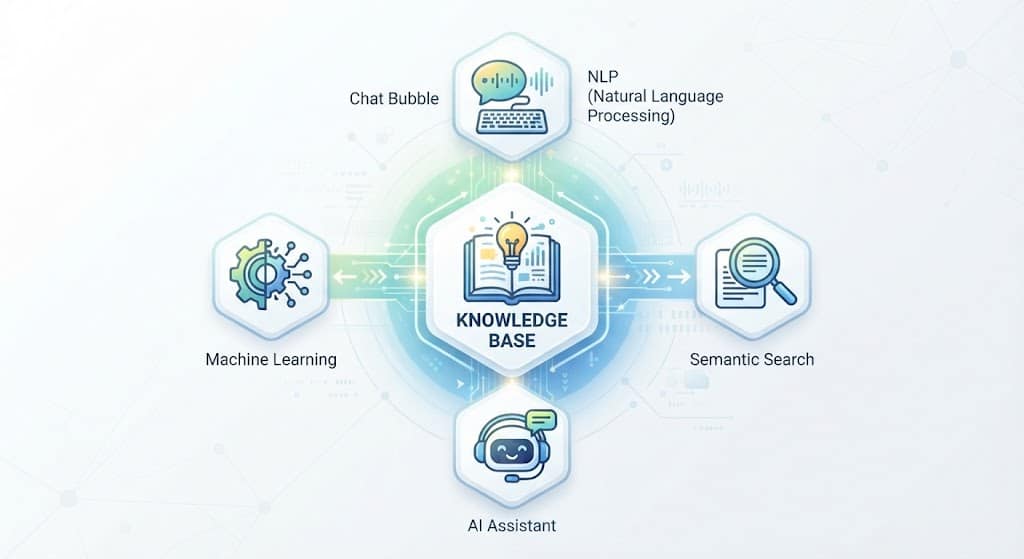
Not all “AI” in knowledge management works the same way. Here’s a breakdown of the main technologies and what they actually do:
| Technology | What It Does | Example Use Case |
|---|---|---|
| Natural Language Processing (NLP) | Understands human language, including intent and context | Employee types “how do I reset a password?” and gets the right article instantly |
| Machine Learning (ML) | Learns patterns from data to improve results over time | System learns which articles are most useful and ranks them higher |
| Semantic Search | Searches by meaning, not just exact keyword matches | Searching “leave policy” also surfaces documents titled “time-off guidelines” |
| Large Language Models (LLMs) | Generate human-like text and summarise long documents | Auto-summarising a 40-page report into key bullet points |
| Retrieval-Augmented Generation (RAG) | Combines search with generative AI to produce grounded answers with sources | AI chatbot answers a question and cites the exact internal document it used |
| Knowledge Graphs | Maps relationships between people, topics, and documents | Shows how a product decision links to a policy, a project, and a team |
Each of these plays a different role, and most modern AI-powered knowledge management platforms combine several of them rather than relying on just one.
How Artificial Intelligence and Knowledge Management Systems Work Together
Here’s a simplified breakdown of what happens behind the scenes:
- Data ingestion — The system pulls in content from wherever it already lives: SharePoint, Confluence, Notion, Slack, email, PDFs, and more.
- Processing and tagging — NLP models read the content, extract key topics, and tag it automatically — no manual categorisation needed.
- Indexing — The processed knowledge is stored in a searchable format optimised for meaning-based retrieval, not just keyword matching.
- Query understanding — When someone asks a question, the AI interprets intent rather than matching literal words.
- Retrieval and generation — The system finds the most relevant source material and, in more advanced setups, generates a direct answer using that material (this is the RAG approach mentioned above).
- Continuous learning — User feedback (thumbs up/down, follow-up questions) helps the system improve its future answers.
This is a meaningful shift from older KM tools, which mostly stopped at step three and left the human to do all the searching manually.
Real-World Use Cases of Artificial Intelligence and Knowledge Management
1. IT Help Desks and Internal Support
AI-powered knowledge bases let employees resolve common IT issues themselves — password resets, VPN setup, software access — without opening a ticket, freeing up support teams for complex problems.
2. Customer Service
Support agents (and customer-facing chatbots) pull instantly from product documentation, past resolved tickets, and policy documents to give accurate, consistent answers.
3. Legal and Compliance
Law firms and compliance teams use AI to search across contracts, case files, and regulations, surfacing relevant precedent or clauses in seconds instead of hours.
4. Healthcare
Clinical staff use AI-assisted knowledge tools to quickly reference treatment protocols, drug interactions, and internal procedures — critical when time matters.
5. Software Engineering
Developers query internal documentation and past architecture decisions instead of re-solving problems the team already solved months ago.
6. Sales Enablement
Sales reps ask an AI assistant for the latest pricing, competitive positioning, or case studies mid-call, instead of digging through a shared drive.
Challenges and Limitations of Artificial Intelligence and Knowledge Management
AI isn’t a magic fix, and it’s worth going in with clear eyes about the trade-offs:
- Data quality dependency — AI can only surface knowledge that’s accurate and current; garbage in, garbage out.
- Hallucination risk — Generative AI can occasionally produce confident-sounding but incorrect answers if not properly grounded in verified sources.
- Integration complexity — Knowledge often lives across dozens of disconnected tools, and connecting them all takes real engineering effort.
- Change management — Employees need to trust and actually adopt the new system, which takes training and time.
- Governance and access control — Sensitive knowledge (HR records, legal documents, financial data) needs careful permission management so AI doesn’t surface it to the wrong people.
- Ongoing maintenance — AI systems still need human oversight to review flagged content, correct errors, and retire outdated material.
None of these are reasons to avoid AI in knowledge management — but they are reasons to plan the rollout carefully rather than assuming the technology will run itself.Show Image

Best Practices for Implementing Artificial Intelligence and Knowledge Management
If you’re considering rolling out AI-powered knowledge management, these steps help avoid the most common failure points:
- Audit your existing knowledge first. Know what content you have, where it lives, and how outdated it is before feeding it into any AI system.
- Start with a narrow use case. Pick one team or one problem (e.g., IT support tickets) rather than trying to overhaul everything at once.
- Assign content owners. Someone needs to be responsible for keeping source material accurate — AI amplifies whatever it’s given, good or bad.
- Prioritise grounded answers over generic AI. Favour systems that cite their sources (RAG-based) over ones that generate answers with no traceability.
- Set access controls early. Decide who can see what before the system goes live, not after a mistake happens.
- Train employees on how to use it. Adoption fails when people don’t trust or understand the tool — plan onboarding, not just deployment.
- Measure and iterate. Track metrics like time-to-answer, ticket deflection rate, and user satisfaction, and refine the system based on real feedback.
The Future of AI and Knowledge Management
A few trends are likely to shape where this space goes next:
- Agentic AI — instead of just answering questions, AI systems will start taking action based on knowledge (e.g., automatically updating a document or triggering a workflow).
- Multimodal knowledge — AI will increasingly process not just text, but images, video, and audio as knowledge sources (think: searching a recorded meeting for a specific decision).
- Tighter governance tools — as adoption grows, expect more built-in compliance and audit features to track exactly where an AI-generated answer came from.
- Personalised knowledge delivery — systems will tailor what they surface based on someone’s role, seniority, or current project, rather than showing everyone the same results.
The direction is clear: knowledge management is moving from a passive archive that people have to search, toward an active system that proactively surfaces what people need, when they need it.
Frequently Asked Questions About Artificial Intelligence and Knowledge Management
1. What is the difference between knowledge management and AI knowledge management?
Traditional knowledge management relies on manual organisation and keyword search. AI knowledge management adds machine learning and natural language processing so the system can understand intent, retrieve information by meaning, and even generate summarised answers automatically.
2. Can small businesses use AI for knowledge management, or is it only for large enterprises?
Small businesses can absolutely use it. Many modern KM platforms offer AI features (search, summarisation, chatbots) as built-in tools rather than custom enterprise builds, making them accessible at a much lower cost than a few years ago.
3. Does AI knowledge management replace human experts?
No. AI surfaces existing knowledge faster; it doesn’t create new expertise. Human experts are still needed to create accurate source content, validate AI outputs, and handle situations the AI hasn’t seen before.
4. What is Retrieval-Augmented Generation (RAG) and why does it matter for knowledge management?
RAG combines search with generative AI: the system retrieves relevant source documents first, then generates an answer grounded in that material — usually with a citation. This significantly reduces the risk of the AI making up an answer that sounds plausible but isn’t accurate.
5. How accurate is AI-generated knowledge management content?
Accuracy depends heavily on the quality of the underlying data and whether the system uses grounded retrieval (like RAG) versus pure generation. Well-implemented systems with clean, current source material and citation features tend to be highly reliable; poorly maintained ones can produce outdated or incorrect answers.
6. What industries benefit most from AI knowledge management?
These are the same industries where artificial intelligence and knowledge management adoption is accelerating fastest.
7. How long does it take to implement an AI knowledge management system?
A narrow, single-team pilot can often go live in a few weeks. A full enterprise-wide rollout with proper governance, integrations, and training typically takes several months, depending on how fragmented the existing knowledge sources are.
8. Is it safe to feed sensitive company data into an AI knowledge management tool?
It can be, but only with proper safeguards: role-based access controls, data encryption, and clear policies on what content the AI is allowed to ingest and surface. This should be settled before rollout, not after.
Conclusion: The Future of Artificial Intelligence and Knowledge Management
Artificial intelligence and knowledge management are no longer separate conversations — they’re converging into a single discipline. Where knowledge management once meant static folders and hopeful keyword searches, it now means systems that understand questions, retrieve grounded answers, and keep improving over time.
The organisations getting the most value aren’t necessarily the ones with the flashiest AI tools — they’re the ones that combined AI with clean, well-governed knowledge and a clear rollout plan. If you’re evaluating this for your own team, start small, prioritise accuracy over automation for its own sake, and build from there.