
Learn how computers learn from data, including machine learning, neural networks, training, feedback, algorithms, and real-world AI examples.
How Computers Learn: A Simple Guide to Machine Learning, AI, and Data
If you have ever wondered how computers learn, the answer is surprisingly different from how humans learn. A computer does not sit down, read a book, understand an explanation and remember the lesson in the same way a person does.
Instead, modern computers can be trained using data, algorithms, mathematical models and feedback. During this process, a machine learning system searches for useful patterns in examples and adjusts its internal parameters so that it can produce better results.
This approach is now behind many technologies people use every day. Spam filters decide whether an email is suspicious, recommendation systems suggest videos and products, voice assistants interpret speech, image-recognition systems identify objects, and generative AI models produce text, images and code.
Machine learning is a major branch of artificial intelligence. It allows computers to learn patterns from data instead of requiring programmers to write an individual rule for every possible situation.
But what actually happens when a computer learns?
Let’s break the process down from the beginning.
What Does It Mean When We Say Computers Learn?
The word “learn” can make artificial intelligence sound more human than it really is.
A computer does not have human consciousness, emotions or understanding simply because it has been trained with data. In machine learning, learning means adjusting a mathematical model so that it performs a particular task more effectively.
Imagine you want a computer to recognize pictures of cats.
A traditional program might require rules such as:
- Look for two eyes.
- Look for pointed ears.
- Look for fur.
- Look for a particular face shape.
- Compare the object’s size and position.
The problem is that real-world images are unpredictable. A cat can be sitting, lying down, partly hidden, photographed from different angles or shown in different lighting.
Machine learning takes another approach.
Instead of manually writing every rule, developers can provide the system with many examples. Some examples are labeled “cat” and others are labeled “not cat.”
The learning algorithm examines those examples and adjusts its model to become better at distinguishing the two categories.
After training, the system can receive an image it has never seen before and estimate whether it contains a cat.
That ability to perform well on new examples is extremely important. A machine learning system that simply memorizes its training data has not really solved the problem.
How Computers Learn: The Basic Process
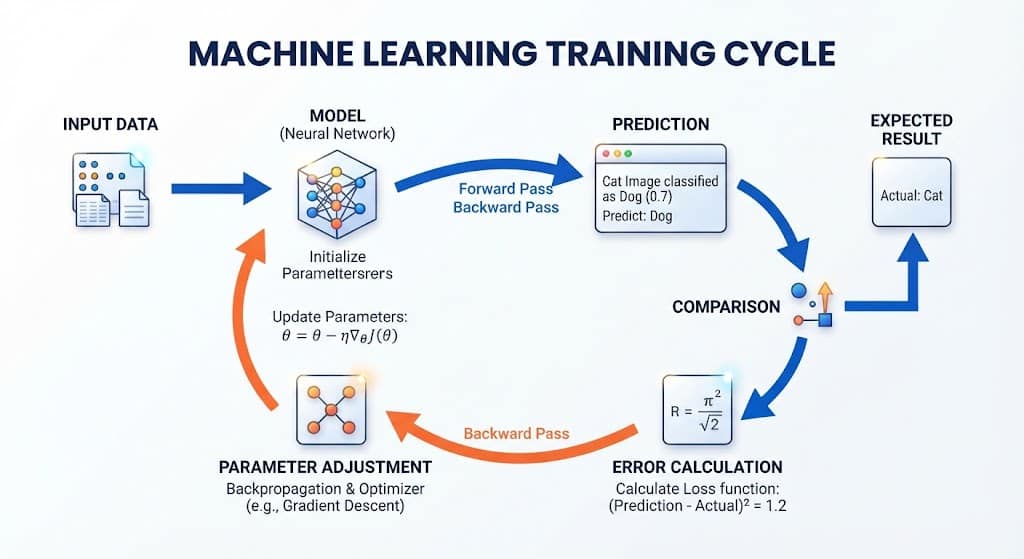
At a high level, the learning process can be understood through a simple cycle:
Data → Training → Prediction → Error → Adjustment → Better Prediction
Here is what happens at each stage.
1. Computers Receive Data
Every machine learning system starts with data.
Depending on the task, the data might contain:
- Numbers
- Images
- Videos
- Audio
- Text
- Sensor readings
- Customer activity
- Weather measurements
- Financial information
- Medical information
- Website interactions
For example, a system designed to predict house prices could receive information about thousands of properties.
Each record might contain:
| Feature | Example |
|---|---|
| House size | 1,800 sq ft |
| Bedrooms | 3 |
| Bathrooms | 2 |
| Location | Urban |
| Age | 10 years |
| Sale price | $250,000 |
The model looks for relationships between these variables.
Perhaps larger houses tend to cost more. Perhaps location has an even stronger effect. Perhaps newer houses command higher prices.
The computer doesn’t necessarily receive these conclusions directly. The learning algorithm attempts to discover useful relationships mathematically.
2. The Data Is Prepared
Raw data is rarely ready for immediate machine learning.
It may contain missing information, duplicate records, inconsistent formats, incorrect values or irrelevant information.
Before training begins, data scientists often clean and organize the dataset.
This can involve:
- Removing duplicates
- Handling missing values
- Correcting errors
- Converting text into numerical representations
- Standardizing measurements
- Selecting useful features
- Labeling examples
- Splitting data into different datasets
This stage is extremely important because poor-quality data can produce poor-quality models.
A sophisticated algorithm cannot automatically turn unreliable information into reliable knowledge.
3. The Computer Looks for Patterns
Once the data is prepared, a machine learning algorithm searches for relationships within it.
Consider a simple example.
Suppose a computer receives information about people’s study time and exam scores:
| Study Hours | Exam Score |
|---|---|
| 1 | 45 |
| 2 | 52 |
| 3 | 60 |
| 4 | 68 |
| 5 | 76 |
| 6 | 84 |
A machine learning algorithm could identify a relationship between study hours and exam performance.
The system is not necessarily learning the sentence:
“Students who study more get better grades.”
Instead, it is adjusting mathematical parameters to represent a relationship between the input and expected output.
With more complicated datasets, those relationships can be far more difficult for humans to identify manually.
4. The Model Makes a Prediction
After finding an initial pattern, the model can make a prediction.
Suppose the model is given information about a house it has never seen before.
It might estimate:
Predicted price: $285,000
The important question is whether that prediction is accurate.
If the actual sale price was $300,000, the model made an error.
That error becomes useful information.
5. The Model Measures Its Error
Machine learning systems use mathematical techniques to measure how far their predictions are from expected results.
This measurement is commonly represented using a loss function or error metric.
For example:
Actual value: $300,000
Predicted value: $285,000
Difference: $15,000
The exact mathematics can become much more complicated, especially in neural networks, but the basic concept is straightforward:
The model needs a way to determine whether its prediction was good or bad.
6. The Computer Adjusts Its Parameters
This is where the actual “learning” happens.
The model changes internal numerical values called parameters.
The objective is to adjust those parameters so that future predictions become more accurate.
In many machine learning systems, optimization methods are used to reduce the model’s error. Neural networks commonly use techniques involving gradients and backpropagation to determine how parameters should change.
The process can happen thousands, millions or even billions of times depending on the model and training task.
Eventually, the model may become very good at the task.
A Simple Example of Computer Learning
Imagine teaching a computer to identify whether an email is spam.
You give it thousands of previous emails.
Some are labeled:
Spam
Others are labeled:
Not Spam
The model might discover that certain combinations of characteristics frequently appear in unwanted messages.
For example, it could find patterns involving:
- Particular words
- Suspicious links
- Unusual sender behavior
- Message structure
- Repeated promotional language
- Other statistical features
Initially, the model will make mistakes.
It may classify legitimate emails as spam.
It may also allow some unwanted messages through.
The system compares its predictions with known results and adjusts its parameters.
After repeated training, it may become considerably better at classification.
This is one of the clearest everyday examples of how computers learn from data.
Supervised Learning: Learning With Examples
One of the most common forms of machine learning is supervised learning.
In supervised learning, the system receives examples where the desired answer is known.
For example:
Input: Photograph
Correct answer: Dog
Or:
Input: House information
Correct answer: $350,000
The model learns the relationship between the input and the known output.
Supervised learning is widely used for:
- Classification
- Fraud detection
- Price prediction
- Image recognition
- Spam filtering
- Medical prediction systems
- Customer churn prediction
The two major supervised learning tasks are often called classification and regression.
Classification
Classification predicts a category.
Examples include:
- Spam or not spam
- Cat or dog
- Fraudulent or legitimate
- Positive or negative review
Regression
Regression predicts a numerical value.
Examples include:
- House price
- Temperature
- Sales revenue
- Delivery time
- Energy consumption
Unsupervised Learning: Finding Hidden Patterns
Computers can also learn from data without being given a correct answer for every example.
This is known as unsupervised learning.
Imagine giving a computer information about millions of customers but not telling it what groups exist.
The algorithm may identify clusters of customers with similar behaviors.
For example, it might discover groups such as:
- Frequent buyers
- Occasional buyers
- Discount-focused shoppers
- High-value customers
Humans can then examine those groups and decide whether they are useful.
Unsupervised learning is commonly associated with discovering structure, similarities and relationships in unlabeled datasets.
Reinforcement Learning: Learning Through Feedback
Another important approach is reinforcement learning.
Instead of receiving a correct answer for every situation, an AI system interacts with an environment and receives feedback.
A simplified example is a game-playing computer.
The system acts.
If the action helps it achieve its goal, it receives a positive reward.
If the action makes the situation worse, it receives a negative reward or less favorable feedback.
Over many attempts, the system can learn which actions tend to produce better results.
Reinforcement learning is particularly useful for situations involving:
- Games
- Robotics
- Decision-making
- Simulations
- Control systems
- Sequential tasks
The basic idea is similar to learning through trial and error, although the underlying mathematics is very different from human learning.
Where Neural Networks Fit In
When people talk about modern AI, they often hear the term neural network.
A neural network is a machine learning model made up of interconnected computational units arranged into layers.
A simplified neural network contains:
Input layer → Hidden layers → Output layer
For an image-recognition system, the input could represent pixels.
The network processes the information through multiple layers.
Different parts of the network can learn different types of patterns.
For example, early layers might respond to simple visual features, while deeper layers can represent increasingly complex combinations.
The model’s parameters are adjusted during training.
Modern deep learning systems can contain extremely large numbers of parameters, and training them requires significant computational resources.
Deep Learning Takes Computer Learning Further
Deep learning is a form of machine learning based on multi-layer neural networks.
It has become particularly important for tasks involving:
- Images
- Speech
- Natural language
- Video
- Generative AI
- Complex pattern recognition
One reason deep learning became so powerful is that neural networks can learn useful representations directly from large datasets rather than relying entirely on humans to manually define every feature.
This does not mean the computer understands information exactly as a human does.
Instead, the network develops mathematical representations that help it perform the task it was trained for.
How Computers Learn From Images
Image recognition provides a useful way to understand modern machine learning.
Suppose developers want an AI system to recognize handwritten numbers.
They can provide thousands of examples of handwritten digits.
The computer converts the images into numerical data.
A neural network processes that information and produces a prediction.
If the image contains the number 7 but the model predicts 3, the training process calculates an error.
The model then adjusts its parameters.
This happens repeatedly across many examples.
Eventually, the network can become highly effective at recognizing patterns associated with different digits.
The same basic concept can be extended to more complicated computer vision tasks.
How Computers Learn From Text
Computers can also learn patterns in language.
Modern language models are trained on very large collections of text and learn statistical relationships between tokens and sequences.
For example, given:
“The sun rises in the…”
a language model can estimate likely next tokens based on patterns it learned during training.
Large language models take this idea to a much larger scale, using neural networks with enormous numbers of parameters.
This is one reason systems can generate answers, summarize documents, translate languages and produce computer code.
However, generating convincing text does not automatically mean that the system possesses human-like understanding or guarantees factual accuracy.
AI systems can produce incorrect information, so important outputs should be checked against reliable sources.
Do Computers Actually Understand What They Learn?
This is one of the most important questions about artificial intelligence.
The short answer is:
Not in the same way humans understand things.
When a machine learning model learns to recognize a dog, it does not necessarily possess a human concept of what a dog is.
It has learned mathematical patterns that help it distinguish dog-related inputs from other inputs.
Likewise, a language model can generate remarkably fluent sentences without having human experiences, emotions or consciousness.
The word “learn” therefore describes the optimization process rather than human-style understanding.
Training Data vs New Data
A major concept in machine learning is generalization.
Suppose you train a model using 100,000 images.
If it performs perfectly on those exact images but fails on every new image, the system has not learned a useful general pattern.
It has effectively memorized its training examples.
This problem is called overfitting.
A useful model should perform well on data it did not see during training.
That’s why machine learning projects commonly separate data into different sets.
| Dataset | Purpose |
|---|---|
| Training data | Used to train the model |
| Validation data | Used to evaluate and tune the model during development |
| Test data | Used for final evaluation |
The exact workflow can vary between projects, but the principle is important: a model should be tested on data that provides a realistic indication of how it will perform in the real world.
What Happens When a Model Makes Mistakes?
Mistakes are not necessarily a sign that machine learning has failed.
They are part of the training process.
During training, developers measure performance and investigate errors.
Suppose an image model correctly identifies most cats but frequently mistakes black cats for another animal.
Developers might investigate:
- Whether enough examples exist
- Whether the training data is balanced
- Whether labels are correct
- Whether the model architecture is appropriate
- Whether the evaluation dataset represents real-world usage
Improving AI is often an iterative process rather than a single training event.
What Makes a Computer Good at Learning?
Several factors influence how well a machine learning system performs.
Quality of Data
High-quality data is essential.
Incorrect, incomplete or biased examples can negatively affect a model.
Quantity of Data
More data can be helpful, especially for complex models, although simply adding more low-quality data does not guarantee better results.
Algorithm and Model Design
Different tasks require different approaches.
A model suitable for predicting house prices may not be suitable for recognizing speech.
Computing Power
Large neural networks can require substantial processing power and memory.
Modern AI development often relies on specialized hardware such as GPUs and other accelerators.
Evaluation
A model must be tested carefully.
High accuracy on one benchmark does not automatically guarantee good performance in every real-world situation.
How Computers Learn From Feedback
Feedback can be extremely important.
Imagine an online recommendation system suggesting videos.
If users frequently click, watch and engage with particular recommendations, that behavior can provide signals about what users may find relevant.
A learning system can use such signals to improve future recommendations.
However, feedback can also create problems.
If the system learns only from what receives immediate engagement, it may reinforce narrow patterns.
This is why AI development requires careful evaluation rather than simply allowing a model to optimize one metric indefinitely.
Can Computers Learn Without Humans?
Not completely in the way the question might suggest.
Humans still play important roles in designing AI systems.
People typically decide:
- What problem the system should solve
- What data should be collected
- What data should be used
- How data should be labeled
- Which model to train
- Which performance metrics matter
- How the system should be evaluated
- What risks need to be controlled
Some machine learning systems can discover patterns without humans manually specifying every rule, but the overall system still exists within a human-designed process.
Why Data Bias Matters
One of the biggest challenges in machine learning is biased or incomplete data.
Consider a facial recognition system trained using an unbalanced dataset.
If some groups are poorly represented, the model may perform differently across populations.
The same principle applies to many other applications.
If the training data does not adequately represent the environment where the model will operate, its predictions may be unreliable.
This is why responsible AI development requires attention to:
- Data quality
- Representation
- Privacy
- Security
- Evaluation
- Transparency
- Human oversight
Machine learning can reproduce problems present in its data rather than automatically eliminating them.
How Computers Learn in Everyday Technology
You may interact with machine learning systems more often than you realize.
Search Engines
Search systems use sophisticated algorithms to determine which information is most relevant to a query.
Streaming Recommendations
Platforms can analyze viewing behavior to recommend content that may interest you.
Email Spam Filters
Machine learning can help identify unwanted messages based on patterns in email data.
Voice Recognition
Speech-recognition systems convert spoken language into digital representations and interpret the resulting patterns.
Fraud Detection
Financial systems can analyze transactions for unusual patterns that may indicate suspicious activity.
Image Recognition
AI can identify objects, faces, text and other patterns in images.
Generative AI
Modern generative AI systems use machine learning to generate text, images, audio, code and other content.

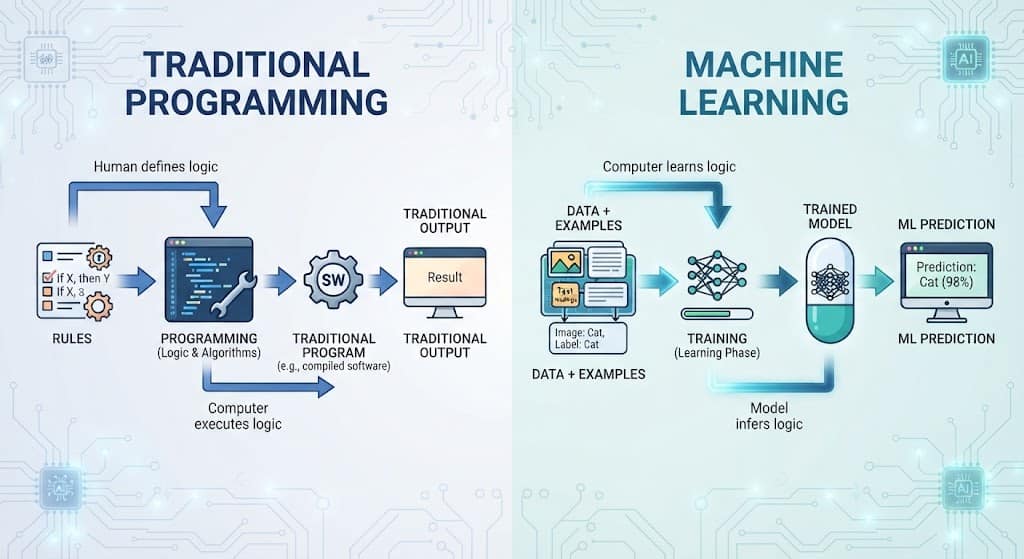
How Machine Learning Differs From Traditional Programming
Traditional programming generally follows this model:
Rules + Data → Output
A programmer explicitly writes instructions that tell the computer what to do.
Machine learning often reverses part of the process:
Data + Expected Results → Training → Model
The model learns parameters that can later be used to produce predictions.
This difference becomes especially valuable when the rules are too complicated to write manually.
Imagine trying to create explicit rules for every possible way a person might write the same sentence.
That would be extremely difficult.
A machine learning model can instead learn statistical patterns from large quantities of language data.
Does More Data Always Make AI Smarter?
No.
More data can help, but quality, relevance and diversity matter.
Consider a dataset containing one million incorrect labels.
Adding more examples with the same problems does not automatically solve the problem.
A useful dataset should be:
- Relevant to the task
- Sufficiently representative
- Carefully processed
- Appropriately labeled where labels are required
- Checked for errors
- Suitable for the intended application
The relationship between data and model performance is therefore more complicated than simply “more data equals better AI.”
What Is the Role of Algorithms?
An algorithm is a defined procedure for solving a problem or performing a task.
In machine learning, algorithms determine how a model can learn from data.
Different algorithms work differently.
Examples include:
- Linear regression
- Decision trees
- Random forests
- Support vector machines
- Clustering algorithms
- Neural networks
- Reinforcement learning algorithms
The choice depends on the problem, available data, performance requirements and other technical considerations.
The algorithm does not magically create knowledge. It provides a mathematical procedure through which the system can extract patterns from data.
What Are Parameters in Machine Learning?
Parameters are internal values that a model learns during training.
In a neural network, parameters include weights and biases.
During training, these values are repeatedly adjusted.
Imagine a model initially gives an image a 40% probability of being a cat.
After training adjustments, it might give the same type of image a 95% probability.
That improvement comes from changes to the model’s internal parameters.
Modern AI models can contain extremely large numbers of parameters, but a larger parameter count alone does not guarantee that a model will be more useful or accurate.
What Happens After Training?
Once training is complete, the model can be used for inference.
Inference means applying the trained model to new input.
For example:
Training:
The model learns from thousands of cat and non-cat images.
Inference:
You provide a new photograph.
Output:
The model predicts whether the image contains a cat.
Training can require significant computational resources, while inference can often be performed much more efficiently depending on the model and application.
Can You Learn How Computers Learn Without Being a Programmer?
Yes.
You do not need advanced programming knowledge to understand the basic concepts.
A good beginner path is:
- Learn what artificial intelligence means.
- Understand the difference between AI and machine learning.
- Learn how datasets work.
- Understand supervised and unsupervised learning.
- Learn the basic idea behind neural networks.
- Study training, validation and testing.
- Experiment with simple machine learning projects.
- Learn Python if you want to build models yourself.
Google provides a practical Machine Learning Crash Course covering fundamental machine learning concepts, interactive material and exercises.
For deeper technical understanding, studying mathematics such as statistics, probability, linear algebra and calculus can be extremely useful.
A Simple Mental Model for Understanding AI Learning
If all the technical terminology feels overwhelming, remember this five-step model:
See
The computer receives examples.
Compare
It compares predictions with expected results or evaluates feedback.
Measure
It calculates how well it performed.
Adjust
It changes internal parameters.
Repeat
It repeats the process many times.
That simple cycle explains a large part of modern machine learning.
Of course, real AI systems can be enormously more complicated, but the underlying idea remains useful.
The Future of Computer Learning
Computers are becoming increasingly capable of processing different types of information together.
Modern AI systems can work with combinations of:
- Text
- Images
- Audio
- Video
- Code
- Structured data
This is contributing to the development of increasingly capable multimodal AI systems.
However, progress does not eliminate fundamental challenges.
Future AI systems will still need to address questions involving:
- Accuracy
- Reliability
- Privacy
- Security
- Bias
- Explainability
- Computing costs
- Energy consumption
- Human oversight
The most useful systems will not simply be those that produce impressive demonstrations. They will need to work reliably in the environments where people actually use them.
Frequently Asked Questions About How Computers Learn
How do computers learn?
Computers learn through machine learning algorithms that analyze data, identify patterns, make predictions, measure errors, and adjust internal parameters. Repeating this process allows the model to improve its performance on the task it was trained for.
Do computers learn like humans?
No. The word “learn” is used because machine learning systems improve their performance from examples or feedback. Their mathematical learning process is fundamentally different from human learning, experience and understanding.
What do computers need to learn?
They generally need relevant data, a suitable learning method, computational resources and a clearly defined objective. Depending on the approach, they may also need labeled examples or feedback.
Can AI learn from mistakes?
Yes. Many machine learning systems use errors or feedback during training to adjust their parameters and improve future predictions.
What is machine learning in simple words?
Machine learning is a way of creating computer systems that learn useful patterns from data instead of relying entirely on manually written rules.
Is machine learning the same as AI?
No. Machine learning is a major approach within artificial intelligence. AI is the broader field, while machine learning focuses on systems that learn patterns from data.
Do computers need millions of examples to learn?
Not always. The amount of data required depends on the task, model, data quality and learning approach. Some systems can learn useful patterns from relatively small datasets, while large deep learning models often benefit from enormous datasets.
Can a computer learn by itself?
A trained machine learning system can discover patterns and update behavior according to its learning method, but humans still play important roles in defining objectives, selecting data, designing systems and evaluating results.
Final Thoughts: How Computers Learn
So, how computers learn can be summarized without the complicated mathematics.
A computer receives data. A machine learning algorithm processes that information and searches for patterns. The model makes predictions, compares them with expected outcomes or feedback, measures its errors, and adjusts its internal parameters. By repeating this process, the model can become better at a particular task.
This approach is fundamentally different from traditional programming because developers do not necessarily have to specify every rule manually. Instead, the computer can learn useful patterns from examples.
That idea powers everything from spam detection and recommendations to computer vision, speech recognition and modern generative AI.
The important thing to remember is that machine learning is not magic. Computers do not automatically understand the world simply because they process huge amounts of information. Their capabilities depend on data, algorithms, model design, training, evaluation and careful human decisions.
Understanding this process gives you a much clearer picture of what artificial intelligence really is and why how computers learn has become one of the most important concepts in modern technology.