Learn what integrated machine learning really means, the main integration patterns, real-world examples, and how to embed ML models into live systems successfully.
Integrated Machine Learning: How to Embed ML Into Your Systems the Right Way
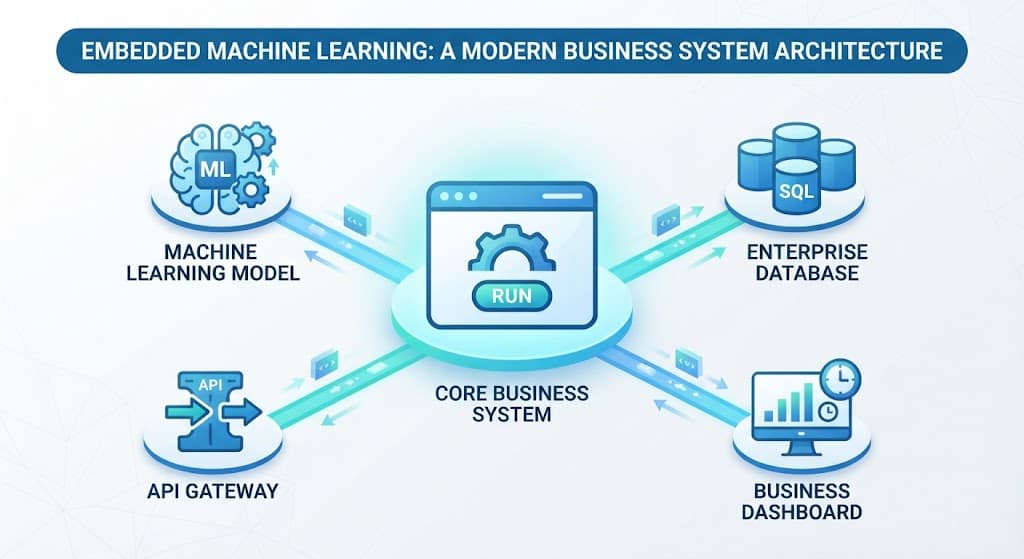
Integrated machine learning is the practice of embedding trained models directly into existing software systems, applications, and workflows so predictions and insights are delivered automatically, in real time, without manual intervention. Instead of a data scientist running a script and emailing results, the model becomes a living part of the product itself.
This guide breaks down what integrated machine learning actually looks like in practice, the architectures behind it, common integration patterns, real-world examples, and the mistakes that trip up teams attempting it for the first time.
What Does “Integrated Machine Learning” Actually Mean?
Integrated machine learning refers to connecting a trained ML model to a live system so it can receive input, generate a prediction, and return that prediction to a user or another system automatically — usually without a human triggering each step manually.
It’s the difference between these two scenarios:
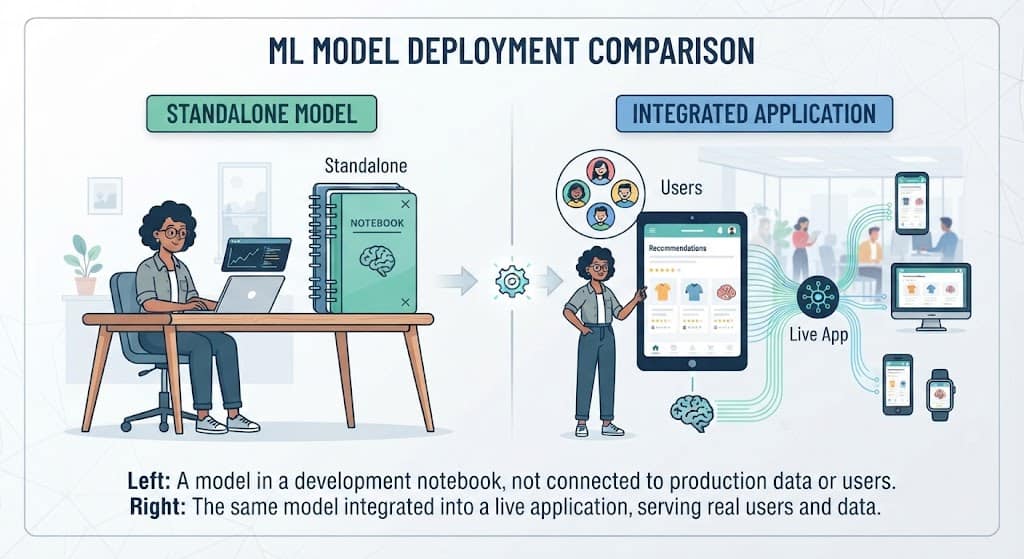
- Not integrated: A data scientist builds a churn-prediction model in a notebook, runs it manually once a month, and shares a spreadsheet of results with the marketing team.
- Integrated: That same churn model runs automatically every time customer data updates, and flags at-risk customers directly inside the CRM dashboard the sales team already uses.
The second scenario is what makes machine learning genuinely useful at scale. A model sitting in a notebook creates insight; an integrated model creates action.
Why This Distinction Matters
A large share of machine learning models never make it into production, and the gap is rarely about accuracy. IBM describes this operational layer as machine learning operations, or MLOps — the practices and tools organizations use to streamline the deployment, management, and monitoring of models once they leave the experimentation stage. You can see IBM’s full breakdown of this discipline in its overview of MLOps. Integration — not model accuracy — is often the actual bottleneck.
The Core Components of an Integrated ML System
Before looking at integration patterns, it helps to understand the pieces that typically need to connect.
| Component | Role in Integration |
|---|---|
| Trained model | The core ML artifact that makes predictions |
| Feature pipeline | Prepares and transforms raw data into the format the model expects |
| Serving layer | Exposes the model so other systems can request predictions |
| Application/product | The software where predictions are actually used or displayed |
| Monitoring layer | Tracks model performance and data drift after deployment |
| Feedback loop | Captures outcomes to retrain and improve the model over time |
A model that isn’t connected to these surrounding pieces is essentially isolated — technically functional, but practically inert.
Common Patterns for Integrating Machine Learning
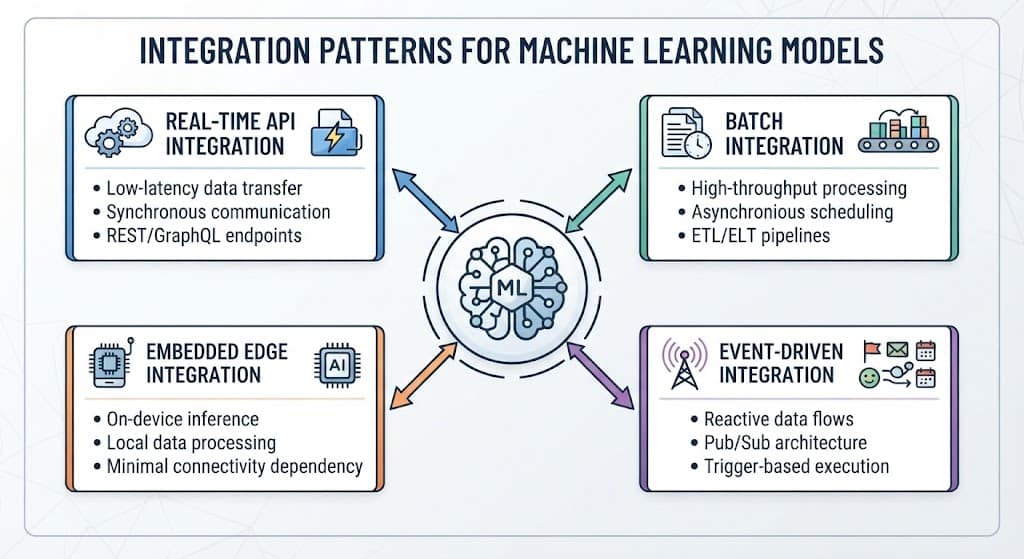
There isn’t one universal way to integrate ML into a system. The right pattern depends on how fast predictions are needed, how the application is built, and how much infrastructure a team already has.
1. Real-Time API Integration
The model is wrapped in an API (often using frameworks like FastAPI or Flask), and the application sends a request whenever it needs a prediction—for example, a fraud-detection check during checkout.
Best for: Situations requiring instant predictions, such as fraud detection, recommendation engines, or chatbots.
Trade-off: Requires reliable infrastructure to keep response times low, since users are often waiting on the result.
2. Batch Integration
Instead of predicting on demand, the model processes large volumes of data on a schedule (hourly, daily, weekly) and writes results into a database or dashboard that the application later reads from.
Best for: Use cases where real-time speed isn’t critical, such as churn scoring, demand forecasting, or monthly risk assessments.
Trade-off: Predictions can become stale between batch runs if underlying data changes quickly.
3. Embedded/Edge Integration
The model runs directly on a device — a phone, sensor, or piece of hardware — rather than calling out to a remote server. This is common in mobile apps and IoT devices.
Best for: Situations requiring low latency, offline functionality, or data privacy (e.g., on-device photo recognition, voice assistants).
Trade-off: Devices often have limited processing power, so models need to be optimized or compressed to run efficiently.
4. Event-Driven Integration
The model is triggered automatically by specific events — a new user signing up, a transaction occurring, a sensor reading crossing a threshold — rather than a fixed schedule or direct request.
Best for: Workflows where predictions need to happen reactively, such as sending a personalized offer immediately after a cart abandonment.
Trade-off: Requires event-streaming infrastructure (like message queues) to be set up correctly.
Real-World Examples of Integrated Machine Learning
Seeing how established companies use integrated ML makes the concept far more concrete.
- E-commerce recommendation engines: Product suggestions (“customers also bought…”) are generated by models integrated directly into the browsing experience, updating in real time as a user clicks around.
- Email spam filters: Every incoming email is scored by a model integrated directly into the mail server before it ever reaches an inbox.
- Banking fraud detection: Transactions are evaluated by a model in milliseconds, integrated directly into the payment authorization process.
- Ride-sharing pricing: Demand-prediction models are integrated into pricing engines to adjust fares dynamically based on real-time conditions.
- Customer support chatbots: Natural language models are integrated into chat widgets, classifying intent and routing conversations automatically.
None of these examples involve a person manually running a model and copying results elsewhere. The intelligence is baked directly into the product experience.
How to Plan an Integrated Machine Learning Project
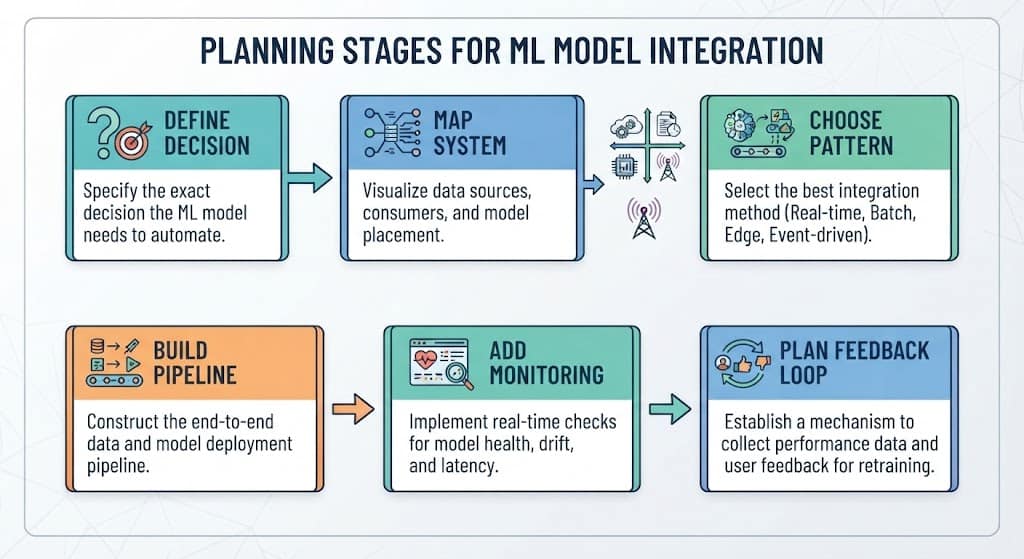
For teams approaching this for the first time, jumping straight into model-building before planning the integration is one of the most common mistakes. A more reliable approach follows these steps.
Step 1: Define the Decision, Not Just the Prediction
Before building anything, get specific about what action will actually change based on the model’s output. If a churn-prediction score doesn’t change what the sales team does differently, the integration has no real value — regardless of how accurate the model is.
Step 2: Map the Existing System
Identify exactly where the prediction needs to appear and what data is available at that moment. This usually involves collaborating with the engineering team that owns the application, not just the data science team.
Step 3: Choose the Integration Pattern
Based on latency requirements (real-time vs. batch) and infrastructure realities, select one of the patterns covered earlier.
Step 4: Build the Feature Pipeline First
A frequent failure point is training a model on clean, historical data that doesn’t match what’s actually available in the live system at prediction time. Building and testing the live feature pipeline early avoids this mismatch.
Step 5: Add Monitoring Before Launch
Set up tracking for prediction accuracy, response times, and data drift before going live, not after problems appear. According to Google’s own machine learning engineering guidance, monitoring for training-serving skew and data drift is one of the most critical — and most frequently skipped — steps in production ML systems, as detailed in Google’s Rules of Machine Learning guide.
Step 6: Plan the Feedback Loop
Decide how outcomes will be captured to retrain the model later. Without this, model performance tends to degrade silently as real-world conditions shift — a phenomenon known as model drift.
Tools Commonly Used for Machine Learning Integration
Several tools and frameworks have become standard for connecting models to live systems.
| Category | Common Tools |
|---|---|
| Model serving | TensorFlow Serving, TorchServe, MLflow |
| API frameworks | FastAPI, Flask |
| Workflow orchestration | Apache Airflow, Kubeflow Pipelines |
| Containerization | Docker, Kubernetes |
| Feature stores | Feast, Tecton |
| Monitoring | Evidently AI, Prometheus, Grafana |
| Cloud ML platforms | AWS SageMaker, Google Vertex AI, Azure Machine Learning |
Smaller teams don’t need every tool on this list. Many production systems start with something as simple as a Flask API and a scheduled script, then adopt more specialized infrastructure as usage grows.
Common Challenges When Integrating Machine Learning
Even well-planned integrations run into predictable friction points. Knowing them in advance helps teams avoid costly rework.
- Training-serving skew – When the data used to train a model differs from the data it sees in production, accuracy drops unexpectedly.
- Latency constraints – Some applications need predictions in under 100 milliseconds, which limits model complexity or requires optimization techniques.
- Versioning confusion – Without clear model versioning, teams lose track of which model produced which prediction, complicating debugging.
- Data drift – Real-world patterns change over time, so a model trained on last year’s data may quietly become less accurate.
- Organizational silos – Data science and engineering teams sometimes work in isolation, leading to integration plans that don’t match actual system constraints.
- Explainability requirements – In regulated industries like finance or healthcare, integrated models often need to justify their predictions, not just produce them.
A Practical Checklist Before Going Live
- [ ] Model performance validated on live-like data, not just historical test sets
- [ ] Response time tested under realistic load
- [ ] Monitoring dashboards set up for accuracy and drift
- [ ] Rollback plan in place if the model underperforms
- [ ] Clear ownership assigned for ongoing maintenance
- [ ] Feedback loop designed for future retraining
Integrated Machine Learning vs. Standalone Machine Learning
It’s worth clarifying this distinction directly, since it’s often the source of confusion for beginners.
| Aspect | Standalone ML | Integrated ML |
|---|---|---|
| Where it runs | Notebook, local script | Live application or system |
| How often it’s used | Manually, on demand | Automatically, continuously |
| Who benefits | Usually the data science team | End users or downstream business processes |
| Maintenance needs | Minimal | Ongoing monitoring and retraining |
| Business impact | Indirect (informs decisions) | Direct (drives automated actions) |
Both approaches have their place. Standalone modeling is valuable for exploration, research, and one-off analysis. Integrated machine learning is what turns that research into a repeatable, scalable product feature.
Best Practices for Long-Term Success
Once a model is integrated, keeping it reliable over time requires ongoing discipline, not a one-time setup.
- Retrain on a schedule, not just when something breaks. Waiting for visible failure usually means damage has already occurred.
- Log every prediction. Historical logs make it possible to diagnose issues and retrain more effectively later.
- Set clear performance thresholds. Define in advance what accuracy or error rate should trigger a review or rollback.
- Keep humans in the loop for high-stakes decisions. Fully automated decisions in areas like lending or hiring often still require human review to catch edge cases and reduce bias risk.
- Document the integration architecture. Team turnover is inevitable; clear documentation prevents knowledge loss.
Frequently Asked Questions
What is the difference between machine learning and integrated machine learning?
Machine learning refers to the broader discipline of training models to learn patterns from data. Integrated machine learning specifically refers to connecting a trained model into a live system so its predictions are used automatically in real workflows.
Do small businesses need integrated machine learning?
Not always. For simple, infrequent analysis, standalone models run manually may be sufficient. Integration becomes valuable once predictions need to happen repeatedly, quickly, or at a scale beyond what manual processes can handle.
Is integrating machine learning difficult for non-technical teams?
The modeling itself often requires data science expertise, but many integration tools (like no-code ML platforms) have made deployment more accessible. That said, production-grade integration typically still benefits from engineering involvement.
How long does it take to integrate a machine learning model into an existing system?
This varies widely based on complexity, but simple API-based integrations can sometimes be completed in days to weeks, while more complex, high-stakes systems with strict monitoring and compliance requirements can take months.
What causes integrated ML systems to fail after launch?
The most common causes are data drift, training-serving skew, lack of monitoring, and insufficient planning for retraining — not the original model’s accuracy.
Final Thoughts
Integrated machine learning is what separates a promising prototype from a system that genuinely changes how a business operates. The modeling work — choosing algorithms, tuning parameters, validating accuracy — is only part of the equation. The real payoff comes from thoughtfully connecting that model into the systems people already use, with the right integration pattern, solid monitoring, and a clear plan for what happens after launch.
Whether you’re building a fraud-detection system, a recommendation engine, or a simple churn score inside a CRM, the same principle holds: a model that isn’t integrated into a real workflow is just an experiment. One that is properly integrated becomes infrastructure.