Most people still think of Artificial Intelligence as a chatbot that answers questions or a filter that recommends what to watch next. That gap in understanding is exactly why so many individuals and businesses feel left behind in 2026.
The truth is that AI has quietly moved from a background tool into an active decision-maker. It now plans workflows, runs parts of businesses, diagnoses diseases, and increasingly operates with little human input at all.
The solution isn’t to chase every new AI tool that trends online. It’s to build a clear, structured understanding of what Artificial Intelligence actually is today, how it works, where it’s headed, and how to use it responsibly.
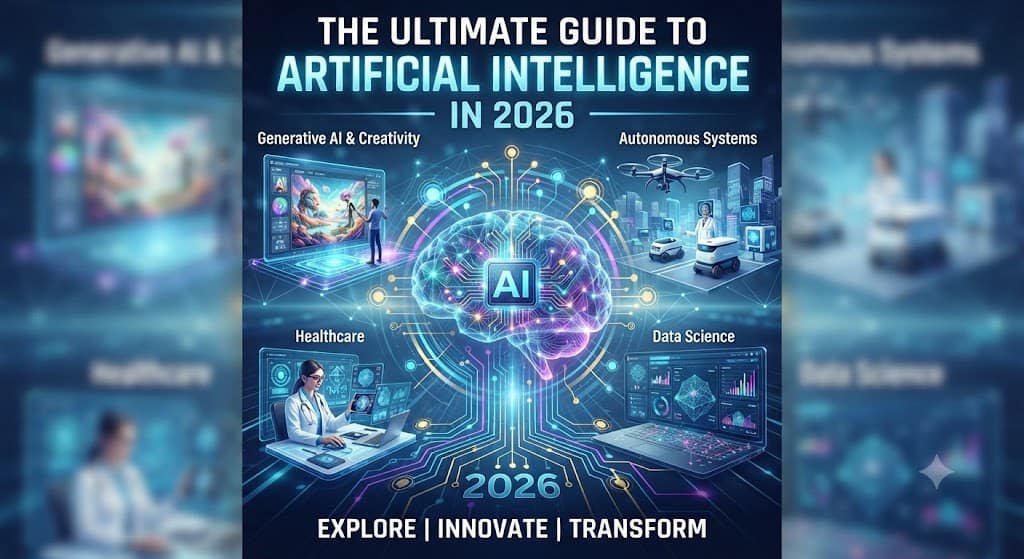
This guide delivers a complete, up-to-date map of Artificial Intelligence in 2026, from core definitions to real-world applications, regulation, and future trends.
What Is Artificial Intelligence?
Artificial Intelligence refers to computer systems designed to perform tasks that normally require human intelligence. This includes learning from data, reasoning through problems, understanding language, recognizing patterns, and making decisions.
Unlike traditional software that follows fixed instructions, AI systems are built to improve as they process more data. They refine their outputs the more they are used.
In 2026, this definition has expanded considerably. AI is no longer confined to narrow, single-purpose tools. It now spans a spectrum:
- Systems that simply analyze information and return a result.
- Systems that generate entirely new content.
- Systems that can independently plan and execute multi-step tasks.
Understanding where a given AI tool falls on that spectrum is the first step toward understanding the technology itself.
The Three Core Types of AI Shaping 2026
Modern AI generally falls into three functional categories. Knowing the difference matters because each type solves a different kind of problem.
1. Analytical (Regular) AI
This is the foundational form of AI, built to process data and perform specific, well-defined tasks. It follows patterns learned from historical data and is commonly used in recommendation engines, fraud detection systems, and spam filters. Its role is to interpret information and return a useful, targeted output.

2. Generative AI
This category focuses on creating new content — text, images, video, audio, and even software code — rather than simply analyzing existing data. Generative AI has driven much of the innovation seen in marketing, design, and software development over the past two years.
3. Agentic AI
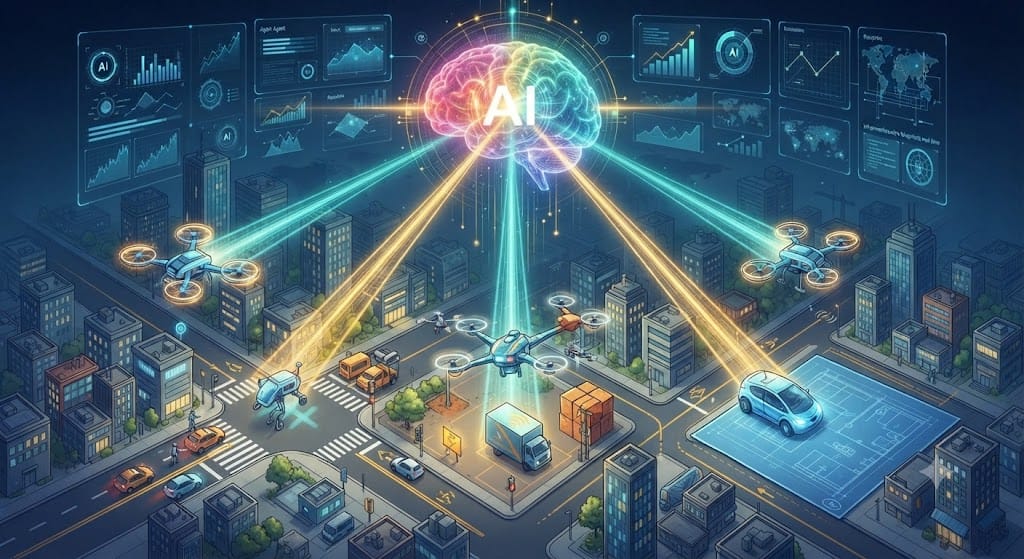
The newest and most transformative category. Agentic systems don’t just respond to prompts; they can plan a sequence of actions, break a large task into smaller steps, and complete that task with minimal human oversight. This capability allows AI to manage complex, multi-stage workflows rather than single, isolated tasks.
Theoretical Concepts
It’s also worth distinguishing these practical categories from two theoretical concepts that come up often in 2026 discussions:
- Artificial General Intelligence (AGI): A hypothetical AI capable of understanding and performing any intellectual task a human can.
- Artificial Super Intelligence (ASI): A still-speculative stage where AI would exceed human capability across nearly all domains.
Neither AGI nor ASI exists yet. Despite the hype, both remain theoretical as of 2026.
How Artificial Intelligence Has Evolved to Reach This Point
AI’s current capabilities didn’t appear overnight. The technology has progressed over roughly seven decades, moving from simple rule-based systems to today’s advanced deep learning models.
- Early Expert Systems: Followed rigid “if-this-then-that” logic.
- Machine Learning & Deep Learning: Enabled models to recognize complex patterns across massive datasets.
- Large Language Models & Agentic Frameworks: Expanded what AI can understand and execute.
This trajectory matters because it shows AI’s growth isn’t slowing down. Each generation of the technology has built on the last at an accelerating pace, which is why 2026 feels like such a pivotal year for the field.
Real-World Applications of AI in 2026
AI’s influence now touches nearly every major industry. Its practical value is best understood through specific use cases:
- Healthcare: Supports faster, more accurate diagnostics in specialties like dermatology and oncology, while contributing to treatment planning and patient monitoring.
- Finance: Powers fraud detection, algorithmic trading, credit risk assessment, and personalized financial guidance.
- Agriculture: Optimizes land and resource use through irrigation timing, weather-informed planning, and targeted pest management.
- Cybersecurity: Acts as a frontline defense by identifying unusual network behavior before it escalates into a full breach.
- Entertainment and Gaming: Powers recommendation engines, generates visual effects, and brings game characters to life with natural-language capabilities.
- Legal Services: Automates routine work like document review and standard filings, making legal support more accessible.
- Smart Cities: Integrates AI across transportation, energy, and infrastructure systems to manage growing populations efficiently.
Key AI Trends Defining 2026
Several converging trends explain why 2026 is being treated as a turning point for the industry:
- Generative AI Expansion: Accelerating innovation across marketing, design, and software development.
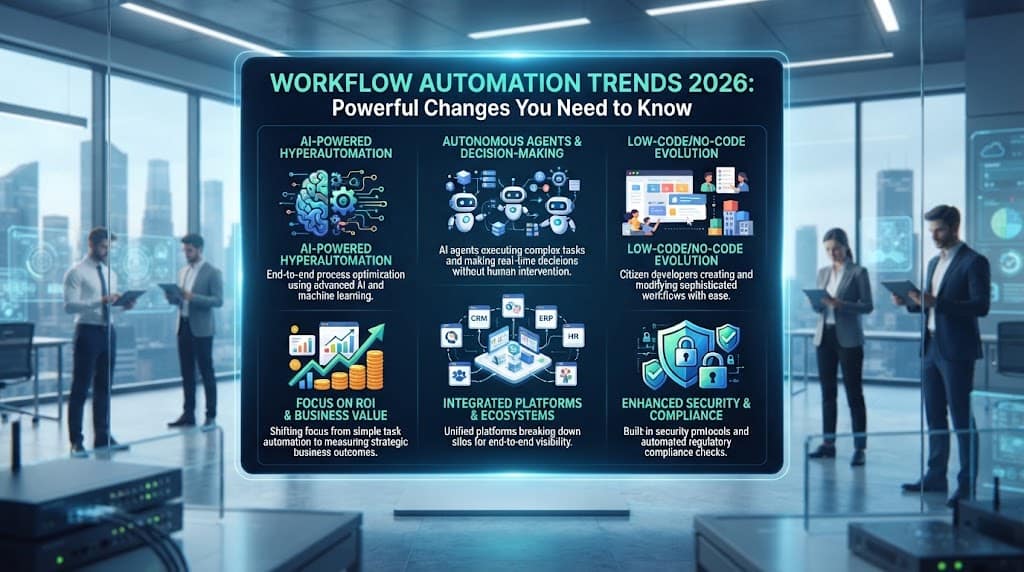
- Agentic AI Adoption: Reshaping how businesses automate operations through multi-step workflows.
- Multimodal AI: Processing and generating across text, image, audio, and video simultaneously.
- AI in Everyday Devices: Embedding AI directly into smart home systems, wearables, and IoT devices.
- Quantum-Assisted AI: Early-stage research intersecting quantum computing with massive parallel computation.
- Rising AI Literacy Demand: Business leaders now consider AI literacy essential for daily work, not just technical roles.
AI Regulation and Ethics: The 2026 Turning Point
2026 marks a genuine inflection point for AI governance, particularly with the European Union’s AI Act. The regulation uses a risk-based framework with four tiers: unacceptable, high, limited, and minimal risk. It directly affects any organization whose AI systems are used within the EU or affect EU residents.
The High-Risk Enforcement Deadline
The most consequential deadline lands on August 2, 2026, when core obligations for high-risk AI systems become enforceable. This covers AI used in employment decisions, credit scoring, biometric identification, and other applications that materially affect people’s rights.
Organizations using AI in these categories must implement:
- Risk assessments
- Technical documentation
- Bias testing
- Human oversight mechanisms
- Continuous monitoring
Non-compliance carries serious financial consequences, with fines reaching into the tens of millions of euros or a meaningful percentage of global annual revenue.
Global Regulation
Beyond Europe, the regulatory picture is fragmented. The United States currently lacks a comprehensive federal AI law, relying instead on a patchwork of state-level rules in places like Colorado, California, Texas, and Illinois.
Ethical questions have grown alongside this regulatory activity. Concerns about algorithmic bias, data privacy, transparency, and accountability remain hot topics of debate worldwide.
Benefits of Artificial Intelligence
The push toward wider AI adoption is driven by measurable, practical benefits:
- Increased productivity through the automation of repetitive tasks.
- Faster, more informed decision-making powered by rapid data analysis.
- Stronger virtual assistants that handle scheduling, research, and communication.
- Improved accuracy in fields like diagnostics and quality control.
- Broader access to specialized knowledge in law, medicine, and finance.
- Enhanced personalization across shopping, entertainment, and learning.
Risks and Challenges to Understand
No balanced guide to AI would be complete without acknowledging its limitations and risks:
- Algorithmic Bias: Embedded training data can lead to unfair or discriminatory outcomes in hiring and lending.
- Data Privacy: Systems require vast amounts of information to function effectively.
- Transparency: Many advanced models operate as “black boxes,” making their decisions difficult to audit.
- Workforce Disruption: AI automates tasks that previously required human labor, while simultaneously creating new job categories.
How to Start Learning AI in 2026
For beginners, the volume of available AI information can feel overwhelming. A structured approach makes it manageable:
- Start with Foundations: Understand the difference between AI, machine learning, and deep learning.
- Move to Hands-On Practice: Experiment with real tools and datasets.
- Use Structured Platforms: Enroll in courses to accelerate progress compared to unguided exploration.
- Build Practical Projects: Small projects cement understanding far better than passive reading alone.
The Future of Artificial Intelligence
Looking beyond 2026, the future of Artificial Intelligence points toward even greater autonomy and integration:
- Predictive Analytics: Processing larger datasets to forecast trends with greater precision.
- Robotics: Becoming more autonomous and adaptable for physical tasks like assembly and logistics.
- Personal Innovation: Accessible tools enabling individuals to build AI-powered projects without technical training.
- Open-Source Development: Fostering transparency alongside thoughtful governance.
Conclusion
Artificial Intelligence in 2026 is no longer a distant, futuristic concept. It is an active force reshaping healthcare, finance, agriculture, cybersecurity, entertainment, and law.
Understanding the different types of AI gives you a genuine advantage, whether you’re a business leader, a professional trying to stay relevant, or simply curious about a changing world.
The individuals and organizations who thrive are those who treat AI not as a mysterious black box, but as a tool to be understood, evaluated, and applied responsibly.