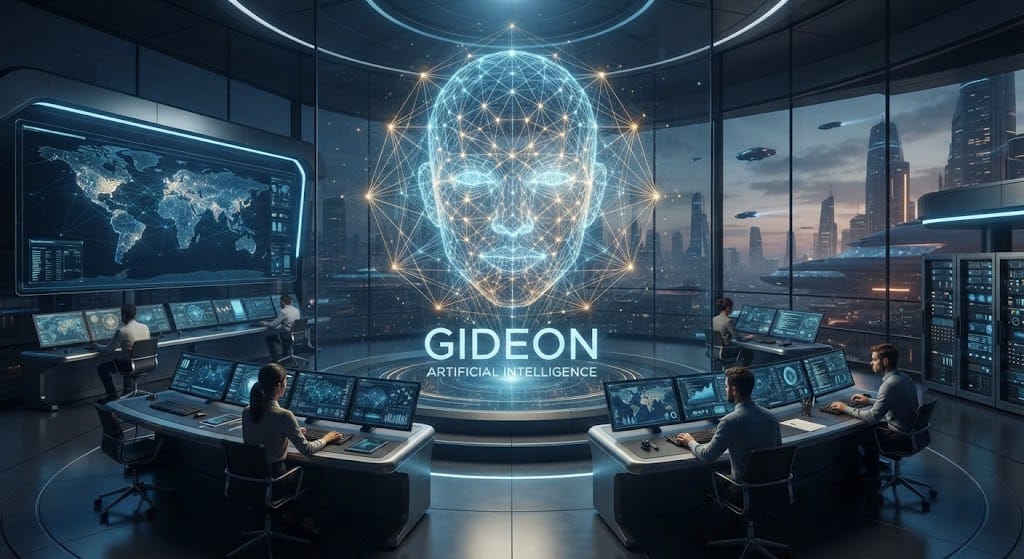
Learn how Gideon artificial intelligence uses AI, 3D vision, robotics and autonomous navigation to transform warehouses, logistics, manufacturing and material handling.
Gideon Artificial Intelligence: How AI-Powered Robots Are Transforming Material Handling
Finding practical information about gideon artificial intelligence can be difficult because the phrase can refer to more than one technology. Today, the most prominent use of the term is connected with Gideon, a robotics and AI company developing autonomous mobile robots for manufacturing, logistics, warehousing, and material handling. The solution is to understand how Gideon combines artificial intelligence, 3D vision, sensors, mapping, and autonomous navigation to help robots perform physical work in environments where conventional automation can struggle.
What Is Gideon Artificial Intelligence?
Finding practical information about gideon artificial intelligence can be difficult because the phrase can refer to different concepts. In the context of modern robotics, it primarily relates to Gideon’s AI-powered autonomous mobile robots, which combine computer vision, 3D perception, mapping, and autonomous navigation for material-handling operations.
If you’re new to the broader subject, our guide to artificial intelligence provides useful background on how modern AI systems are evolving beyond traditional software applications.
Gideon’s technology is particularly interesting because it applies machine intelligence to physical environments. Its robots use AI and 3D vision to perceive their surroundings, understand objects and movement, determine their location, and plan actions. Gideon explains its approach in detail in its official AI and 3D-vision technology overview, which describes the company’s vision, sensor-fusion, localization, and autonomous-navigation systems.
How Does Gideon AI Work?
Gideon’s autonomous systems combine several technologies rather than depending on one AI technique.
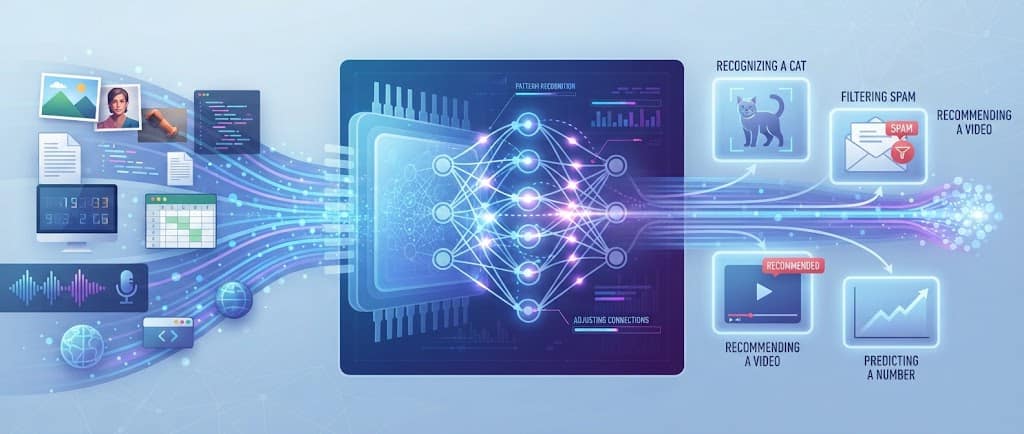
The process can be simplified into four stages:
- Vision: Cameras and sensors collect information about the environment.
- Understanding: AI identifies objects, people, movement, and other relevant features.
- Localization: The robot determines its position using environmental information and 3D mapping.
- Action: The autonomous system plans routes and performs the required material-handling task.
This is closely connected to the way machine-learning systems learn to recognize patterns. If you want to understand the underlying concept, see our guide explaining how computers learn from data.
Gideon’s technology combines sensor fusion, stereo cameras, 3D maps, object recognition, and autonomous navigation. The company says its robots can recognize objects, continuously compare environmental features with stored maps, plan routes, avoid obstacles, and operate around people.e objects and detect their positions while continuously updating their awareness of the environment.
Gideon AI and 3D Vision
3D vision is one of the most important parts of Gideon’s robotics platform.
The system uses visual information to build a richer representation of the environment than a robot would get from a simple two-dimensional image. Gideon’s technology page describes stereo cameras, sensor fusion, object recognition, 3D mapping, and autonomous navigation as components of its perception and autonomy system.
This is particularly useful in warehouses and manufacturing environments where pallets, forklifts, workers, and other equipment can change position throughout the day.
Gideon has also worked with NVIDIA technologies to accelerate parts of its autonomy stack. NVIDIA identifies Gideon among the companies using its Isaac Perceptor platform for perception-based autonomous mobile robots.
For readers interested in the technical side, the NVIDIA Isaac Perceptor robotics platform explains how AI-based perception can help autonomous mobile robots navigate and avoid obstacles in unstructured environments.
Trey: Gideon’s Autonomous Forklift
Trey is one of Gideon’s most visible applications of autonomous robotics.
The autonomous forklift is designed for trailer loading and unloading. Its technology stack includes a vision module, 3D localization, and semantic object detection, allowing the robot to understand its environment and perform material-handling tasks autonomously.
Gideon has also described its collaboration with NVIDIA around technologies including NVIDIA Isaac Perceptor, CUDA, TensorRT, and GPU-accelerated perception. These technologies are intended to support the vision and autonomy capabilities required by autonomous mobile robots.
Why Gideon AI Matters for Warehouse Automation
Warehouse automation is moving beyond fixed machines that repeat the same movement in controlled environments.
Autonomous mobile robots are designed for more dynamic situations. They need to understand changing surroundings, identify obstacles, navigate around people and equipment, and respond to conditions that were not necessarily present when the system was initially deployed.
That makes AI robotics different from simple rule-based automation.
The distinction is important because modern physical AI connects perception with action. A robot doesn’t simply receive a command to move from point A to point B. It must continuously interpret its surroundings and determine how to complete the task safely.
What Technologies Power Gideon’s Robots?
Several technologies work together within Gideon’s autonomous robotics systems:
- Artificial intelligence
- Computer vision
- Stereo cameras
- 3D perception
- Sensor fusion
- Object detection
- 3D mapping
- Localization
- Autonomous navigation
- Obstacle avoidance
- Safety systems
- GPU-accelerated computing
Gideon describes this as a combination of AI and 3D vision that enables its robots to see, understand, localize, and act within physical environments.
This combination is also why the technology fits within the broader physical AI category. Physical AI applies machine intelligence to systems that interact directly with the real world rather than limiting AI to digital information processing.
Navigation and Localization
Autonomous navigation is another important component of Gideon’s technology.
For a mobile robot to work independently, it needs to know its location. Gideon’s systems use 3D maps and environmental features to help robots understand where they are.
The robot can continuously compare what it sees with information stored in its map.
This allows the system to navigate without requiring every movement to be manually programmed.
Navigation also involves obstacle avoidance. A warehouse can contain temporary obstacles that were not present when the robot was originally deployed.
An autonomous robot must therefore respond to changes rather than blindly following a predetermined route.
Safety Features in Gideon AI
Safety is particularly important when autonomous robots operate around people.
Gideon describes several safety mechanisms within its robotic systems, including wide-angle stereo cameras, safety laser scanners, dynamic safety zones, visual and audio signals, and emergency stop controls.
The company’s technology also uses AI-powered autonomy to recognize human forms and predict movement.
The objective is not simply to make robots move faster. The robot must operate within an environment where people and machines share the same workspace.
This human-robot collaboration model is an important part of industrial robotics because completely isolating robots from people is not practical for many modern facilities.
Gideon and Physical AI
The phrase physical AI has become increasingly important as artificial intelligence moves beyond traditional software applications.
Generative AI can write text, create images, summarize documents, or generate computer code. Physical AI applies machine intelligence to systems that interact with the physical world.
Gideon is an example of this approach.
Its robots combine:
- Artificial intelligence
- Computer vision
- 3D perception
- Sensor fusion
- Autonomous navigation
- Mapping
- Robotics hardware
- Safety systems
The result is an AI system that does not simply provide an answer on a screen. It interprets the physical environment and takes action within it.
Gideon and NVIDIA
Gideon announced a collaboration with NVIDIA to accelerate supply-chain AI and automation.
The partnership involves NVIDIA’s robotics ecosystem, including the NVIDIA Isaac platform and Isaac Perceptor technologies.
This relationship illustrates an important trend in robotics: advanced autonomous machines increasingly depend on an ecosystem that combines specialized hardware, AI software, simulation, perception technology, and robotics platforms.
For companies developing autonomous robots, computing performance and perception capabilities can be just as important as the mechanical design of the robot itself.
Real-World Applications
The usefulness of Gideon artificial intelligence becomes clearer when looking at real industrial applications.
Gideon has worked on autonomous material-handling projects with organizations in logistics and manufacturing.
One documented customer project involved DB Schenker’s Leipzig facility, where three autonomous robots were deployed in a pilot project. The testing focused on localization and obstacle avoidance, including the detection of low-lying forklift forks.
This type of testing demonstrates why industrial AI requires more than impressive demonstrations. Autonomous robots must deal with unusual objects, unpredictable environments, and strict operational requirements.
The real challenge is making the system reliable enough for repeated use in working facilities.
Benefits of Gideon AI for Businesses
Organizations considering autonomous mobile robots generally look at several business factors.
1. Increased Productivity
Automation can allow material-handling equipment to operate consistently and support continuous workflows.
2. Reduced Manual Work
Robots can take on repetitive, physically demanding tasks, potentially allowing employees to move toward other responsibilities.
3. Greater Process Predictability
Automated systems can provide consistent execution of defined workflows and generate operational data.
4. Flexible Deployment
Mobile robots can potentially operate in environments where installing extensive fixed automation infrastructure would be difficult.
5. Improved Workplace Ergonomics
Moving heavy materials repeatedly can place physical demands on workers. Automating some of these tasks can reduce exposure to repetitive manual handling.
These benefits should be evaluated against the specific operational environment, deployment requirements, safety procedures, integration costs, and expected return on investment.
Challenges and Limitations
Gideon artificial intelligence does not eliminate all challenges associated with industrial automation.
Autonomous robots still need suitable operating environments, reliable infrastructure, maintenance, software updates, safety procedures, and integration with existing workflows.
AI perception can also be affected by environmental conditions. Lighting, unexpected objects, unusual layouts, and operational changes can create difficult situations for autonomous systems.
Another consideration is integration.
A warehouse robot may need to communicate with warehouse management systems, enterprise software, conveyors, forklifts, loading equipment, and human workers.
Successful automation therefore involves more than buying a robot. Businesses need to analyze the complete workflow.
Gideon AI vs Traditional Automation
Traditional industrial automation is often designed around predictable processes.
For example, a machine may perform the same movement repeatedly in a controlled area.
Autonomous mobile robots operate differently. They are designed to move through environments where conditions can change.
This creates a distinction between fixed automation and adaptive autonomous systems.
Fixed automation can be highly effective for repetitive tasks with stable conditions. Autonomous mobile robots can be more suitable when material movement requires flexibility.
The right approach depends on the operation.
For a highly predictable production line, conventional automation may remain appropriate. For dynamic material-handling environments, autonomous mobile robots can provide another option.
Who Is Gideon?
Gideon is a robotics and artificial intelligence company focused on autonomous mobile robots.
The company has roots in Croatia and has expanded its operations in the United States. Its team includes specialists in robotics, software, engineering, and artificial intelligence.
Gideon’s stated purpose centers on keeping people at the center of automation while using robots to handle difficult physical work.
The company’s technology has evolved from earlier logistics robots into a broader platform focused on autonomous material handling.
The Future of Gideon Artificial Intelligence
The future development of Gideon artificial intelligence is closely connected to the broader evolution of physical AI.
As computer vision, machine learning, robotics hardware, and accelerated computing continue to develop, autonomous machines may become capable of handling increasingly complex industrial workflows.
The major opportunity is not simply creating robots that can move independently. The larger challenge is developing systems that can understand changing environments and safely perform useful tasks in collaboration with people.
Gideon’s work illustrates this transition from traditional automation toward intelligent physical systems.
For warehouses and manufacturers, the long-term question will be how effectively autonomous robots can integrate into existing operations while delivering measurable improvements in productivity, safety, flexibility, and cost.
Frequently Asked Questions
What is Gideon artificial intelligence?
Gideon artificial intelligence refers primarily to the AI, computer vision, perception, mapping, and autonomous-navigation technologies used by Gideon to operate autonomous mobile robots for industrial material handling.
What does Gideon AI do?
Gideon develops autonomous mobile robots designed for manufacturing, logistics, warehousing, retail, and material-handling applications. Its Trey system is designed for autonomous trailer loading and unloading.
Is Gideon an AI company?
Yes. Gideon describes itself as a robotics and AI company specializing in AI- and vision-based autonomous mobile robots.
What technology does Gideon use?
Gideon’s technology combines AI, 3D vision, sensor fusion, mapping, autonomous navigation, object recognition, and safety technologies.
What is Trey by Gideon?
Trey is Gideon’s autonomous forklift designed to automate trailer loading and unloading operations.
Does Gideon AI replace human workers?
Gideon positions its robots as systems that work with people and automate difficult manual material-handling tasks. The practical effect on employment depends on how individual businesses deploy automation, reorganize work, and manage their workforce.
Where can Gideon robots be used?
Gideon targets environments including warehouses, manufacturing facilities, logistics operations, and retail-related material-handling workflows.
Conclusion
Gideon represents an important example of how artificial intelligence is moving from software into physical environments. Its autonomous mobile robots combine AI, computer vision, 3D perception, mapping, localization, and navigation to perform material-handling tasks in warehouses, manufacturing environments, and logistics operations.
The technology behind gideon artificial intelligence is particularly notable because the robot must continuously perceive its surroundings and make decisions while operating around people, pallets, forklifts, and other equipment.
Gideon’s Trey autonomous forklift demonstrates how these technologies can be applied to trailer loading and unloading, while its broader platform illustrates the growing role of physical AI in industrial automation.
For anyone researching the future of AI robotics, Gideon provides a useful real-world example of how machine learning, 3D vision, autonomous navigation, and robotics hardware can work together to solve physical tasks.