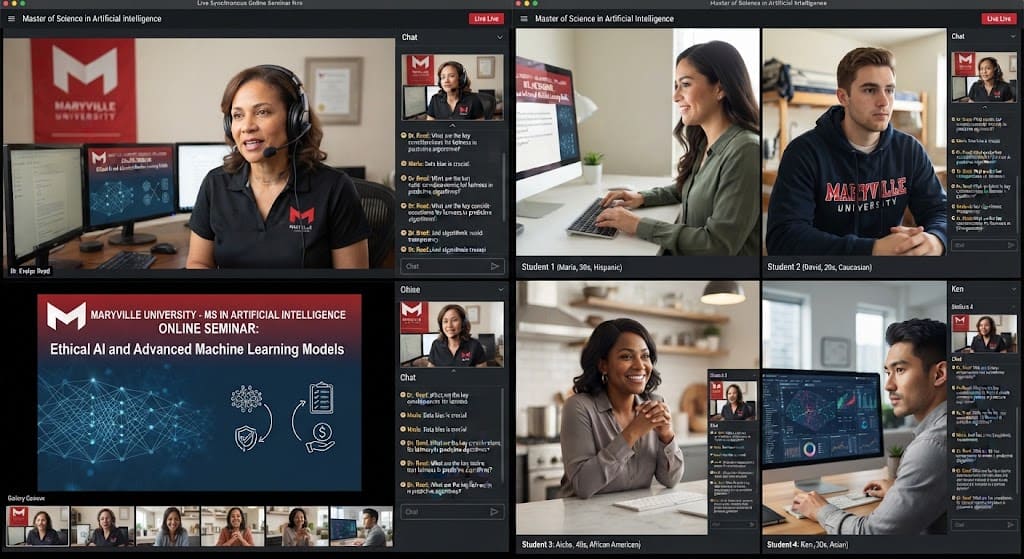
Explore the Maryville University Master of Science in Artificial Intelligence online, including curriculum, tuition, admission, courses, careers, and FAQs.
Maryville University Master of Science in Artificial Intelligence Online: Complete 2026 Guide
Artificial intelligence is changing the way companies build software, analyze data, automate tasks, and make decisions. As AI becomes part of more industries, professionals are looking for structured ways to develop skills in machine learning, programming, deep learning, robotics, and responsible AI.
The Maryville University Master of Science in Artificial Intelligence online program is one option for students and working professionals who want graduate-level AI education without attending traditional on-campus classes.
Maryville’s program is delivered entirely online and combines programming, mathematics, machine learning, deep learning, reinforcement learning, AI ethics, electives, and project-based learning. The university currently lists the degree as a 33-credit program that can be completed in as few as two years by students taking two classes per term.
But is this program suitable for you?
That depends on your background, career goals, technical interests, budget, and expectations from an online master’s degree.
This guide breaks down the Maryville University Master of Science in Artificial Intelligence online program, including its curriculum, admission requirements, tuition, duration, courses, skills, career possibilities, and important considerations before applying.
Quick Overview of the Maryville Online AI Master’s
If you are researching the program for the first time, these are the main details to know:
| Program Feature | Current Information |
|---|---|
| Degree | Master of Science in Artificial Intelligence |
| University | Maryville University |
| Delivery | 100% online |
| Total Credits | 33 credit hours |
| Core Coursework | 24 credits |
| Electives | 9 credits |
| Completion Time | As few as 2 years |
| GRE/GMAT | Not required |
| Campus Visits | Not required for online coursework |
| Programming | Python plus other technology tools |
| Capstone | Included |
| Professional Certificates | Two built-in AI certificates |
| Start Dates | Three start dates per year |
Maryville says students can study online without campus visits and can complete the degree in as few as 24 months when taking two classes per term. The university also highlights project-based learning and two built-in professional certificates.
What Is the Maryville University Master of Science in Artificial Intelligence Online?
The Maryville University Master of Science in Artificial Intelligence online is a graduate program focused on the technical and practical side of artificial intelligence.
Instead of treating AI as a small part of a general computer science curriculum, the program places AI-related subjects at the center of the degree.
Students can study areas such as:
- Artificial intelligence fundamentals
- Python programming
- Mathematics for AI
- Machine learning
- Deep learning
- Reinforcement learning
- Natural language processing
- Robotics
- Text mining
- Image processing
- AI ethics
- Data science
- Practical AI applications
The curriculum is designed to combine technical knowledge with practical project work. Maryville states that the program was developed with an emphasis on experiential learning and real-world AI applications.
That distinction matters.
Learning how to use an AI chatbot is very different from learning how machine-learning models are developed, evaluated, deployed, and improved.
A graduate program is aimed at the second category.
Why Study Artificial Intelligence Online?
An online AI master’s can be attractive to people who already have professional or personal commitments.
Instead of relocating to attend a campus program, students can complete coursework remotely. Maryville says its online AI master’s requires no campus visits and provides access to coursework through Canvas.
There is another advantage: flexibility.
A working software developer, data analyst, IT professional, or business technology specialist may be able to continue working while studying.
However, online does not mean effortless.
Students still need to manage:
- Programming assignments
- Mathematical concepts
- Reading
- Projects
- Discussions
- Deadlines
- Exams or assessments
- Longer-term capstone work
The flexibility comes from the delivery format, not from a reduced academic workload.
Maryville AI Master’s Curriculum Explained
The curriculum is probably the most important part of the degree for prospective students.
Maryville currently lists 33 credit hours for the online MS in Artificial Intelligence. The curriculum consists of 24 credits of core coursework and nine credits of electives.
The required subjects cover several important areas of modern AI.
Mathematics for Artificial Intelligence
Mathematics provides the foundation for many machine-learning techniques.
Maryville’s mathematics course covers concepts including:
- Probability
- Statistics
- Calculus
- Linear algebra
- Optimization
These subjects can help students understand what is happening behind machine-learning algorithms rather than simply treating models as black boxes.
For beginners, this may be one of the more challenging areas of the program.
That is not necessarily a bad thing. Understanding the mathematics can make it easier to evaluate models, understand optimization, interpret results, and communicate with other technical professionals.
Python Programming
Python is one of the most widely used programming languages in data science and machine learning.
The program’s Python coursework covers core Python concepts and commonly used libraries such as NumPy, SciPy, Pandas, Matplotlib, and Scikit-learn. The course also uses project-based learning.
For an aspiring AI professional, this foundation can be useful because real-world AI work usually involves much more than selecting a model.
You may need to:
- Collect data.
- Clean the data.
- Explore the dataset.
- Prepare features.
- Train a model.
- Evaluate the results.
- Improve the approach.
- Communicate the findings.
Python can be involved throughout that process.
Machine Learning
Machine learning is at the heart of modern AI.
The Maryville curriculum introduces supervised learning, machine-learning algorithms, learning theory, reinforcement learning, neural networks, and practical applications.
In simple terms, machine learning allows computers to learn patterns from data and use those patterns to make predictions or decisions.
Examples include:
- Fraud detection
- Product recommendations
- Image classification
- Demand forecasting
- Customer segmentation
- Anomaly detection
- Predictive maintenance
The quality of the result depends heavily on data quality, model selection, evaluation methods, and the problem being solved.
Deep Learning
Deep learning uses neural networks with multiple layers to model complex patterns.
The program introduces advanced neural-network architectures, including convolutional and recurrent networks, along with regression, classification, and generative adversarial networks.
Deep learning is especially relevant to applications involving:
- Images
- Speech
- Text
- Video
- Recommendation systems
- Complex pattern recognition
Students interested in generative AI, computer vision, or advanced machine learning may find this area particularly relevant.
Reinforcement Learning
Reinforcement learning focuses on decision-making through interaction with an environment.
Rather than learning only from labeled examples, an agent can learn from actions and feedback.
This area has applications in:
- Robotics
- Autonomous systems
- Game-playing systems
- Resource optimization
- Sequential decision-making
Reinforcement learning is technically demanding, so students should expect to build on concepts learned in earlier courses.
AI Ethics
Technical skills alone are not enough when AI is used in real-world environments.
AI systems can affect privacy, employment, security, healthcare, finance, and other sensitive areas.
Responsible AI therefore involves questions such as:
- Is the training data appropriate?
- Could the model produce biased outcomes?
- Can users understand important decisions?
- Is personal information protected?
- Who is responsible when an AI system makes a mistake?
An AI professional needs to think about these issues alongside accuracy and performance.
What Electives Are Available?
The nine-credit elective component gives students an opportunity to explore specific interests.
Maryville’s current curriculum lists options including:
- Text Mining
- Robotics
- Applications of Artificial Intelligence
- Internship
The curriculum page also notes that course offerings can change as the university responds to emerging employer and industry trends.
This flexibility can be useful because AI is a broad field.
Someone interested in language-based systems may prefer text mining, while another student may be more interested in robotics or business applications.
What Is the AI Master’s Capstone Project?
The capstone provides an opportunity to bring different skills together.
Rather than studying every subject separately, students can apply their knowledge to a practical AI or data-related project.
Maryville describes its capstone as a project where students work through a realistic problem, including data collection and the application of appropriate analytical methods.
A strong capstone can also become a useful portfolio project.
For example, a student could potentially demonstrate:
- The original problem
- Dataset selection
- Data preparation
- Model selection
- Training process
- Evaluation
- Results
- Limitations
- Future improvements
That gives graduates something concrete to discuss when explaining their technical experience.
How Long Does the Online AI Master’s Take?
Maryville says students can complete the 33-credit degree in as few as 24 months when taking two classes per term.
The actual time required can depend on course scheduling, individual circumstances, transfer credits, and the student’s chosen pace.
Students should therefore treat the two-year figure as a minimum advertised completion timeframe rather than a guarantee for every student.
If you are working full-time, consider how much weekly time you can realistically dedicate to graduate coursework.
A simple schedule might include:
- Weekday evenings for reading and lectures
- One or two focused programming sessions
- Weekend time for larger assignments
- Dedicated project time before deadlines
The exact routine will vary, but consistency is important.
Maryville AI Master’s Admission Requirements
Maryville’s program information states that applicants need a bachelor’s degree from an accredited institution and currently lists a 3.0 minimum GPA for admission.
The university also states that the program does not require GRE or GMAT scores. It offers three start dates per year and describes its admissions process as transfer-credit friendly.
Prospective students should verify the latest requirements directly with the university before applying because admission policies can change.
International applicants should also check any additional documentation or English-language requirements that may apply to them.
Does Maryville Require the GRE or GMAT?
No.
Maryville currently states that applicants to its online AI master’s do not need GRE or GMAT scores.
That can make the application process more straightforward for professionals who already have relevant academic or technical experience.
It does not, however, mean the program is academically easy.
Students still need to be prepared for programming, mathematics, machine learning, and project-based coursework.
How Much Does the Maryville AI Master’s Cost?
Tuition is one area where prospective students should always check the latest university information before making a decision.
The cost can depend on the current per-credit tuition rate, technology fees, course load, transfer credits, financial aid, and other applicable charges.
Rather than relying on an old tuition figure from a third-party website, prospective students should check Maryville’s current tuition information before applying.
When comparing AI master’s programs, calculate the potential total cost rather than looking only at the advertised cost per credit.
Consider:
- Tuition
- Technology fees
- Course materials
- Transfer credits
- Financial aid
- Employer tuition assistance
- Number of semesters
- Time away from other professional activities
The cheapest program on paper is not necessarily the least expensive overall, especially if completion takes longer.
What Skills Can You Develop?
The Maryville University Master of Science in Artificial Intelligence online curriculum covers a broad collection of technical skills.
Depending on your course and elective choices, these can include:
Python and Data Analysis
Students develop programming skills and work with common data-science libraries.
Machine Learning
You learn how algorithms can identify patterns in data and support predictions or decisions.
Deep Learning
Neural-network architectures introduce students to more advanced AI techniques.
Reinforcement Learning
Students explore methods for training systems to make decisions through feedback.
Natural Language Processing
Text mining and language-focused AI can help students understand how machines process large collections of human language.
Computer Vision
Image-related AI involves techniques for extracting useful information from visual data.
Robotics
Robotics connects software intelligence with physical systems and automated decision-making.
Responsible AI
Ethics coursework encourages students to consider the social, legal, and practical consequences of AI.

What Careers Can an AI Master’s Support?
A master’s degree cannot guarantee a job, salary, or specific career outcome.
However, graduate-level AI skills can be relevant to several technical occupations.
Maryville lists potential career paths including:
- AI analyst
- AI data scientist
- AI developer
- AI engineer
- AI interaction designer
- AI solutions architect
- Computer and information research scientist
- Cloud solutions engineer
- Data analyst
- Machine learning engineer
- Natural language processing specialist
- Robotics engineer
Broader U.S. labor-market data also shows strong projected growth in several occupations connected to AI and information technology. The U.S. Bureau of Labor Statistics reported in July 2026 that employment of data scientists is projected to grow 33.5% from 2024 to 2034, while computer and information research scientists are projected to grow 19.7% during the same period.
Those statistics describe occupations across the U.S. labor market. They should not be interpreted as a guarantee for graduates of any particular university.
Experience, location, portfolio projects, technical ability, communication skills, and employer requirements can all affect career outcomes.
Is an AI Master’s Useful for Software Developers?
It can be.
Software developers who already know how to build applications may want to understand how machine-learning models can become part of those applications.
For example, a developer might eventually work on:
- AI-powered search
- Recommendation systems
- Document classification
- Chatbots
- Computer-vision applications
- Predictive analytics
- Automated workflows
- Intelligent software features
A graduate AI program can provide a structured environment for learning the concepts behind those systems.
However, developers should still build practical projects outside coursework whenever possible.
A GitHub portfolio, technical writing, personal projects, internships, or professional AI experience can complement an academic credential.
Is the Program Suitable for Career Changers?
It can be an option, but career changers should assess their starting point honestly.
Someone moving from another technical field may already have useful experience with:
- Programming
- Statistics
- Data
- Cloud computing
- Software development
- Engineering
Someone with no technical background may need additional preparation.
AI is not simply about asking better questions to an AI chatbot. Technical AI work can involve mathematics, algorithms, programming, data processing, model evaluation, and deployment.
Building those foundations before or alongside graduate study can make the transition easier.
Online Learning and Student Support
Maryville says students access online coursework through Canvas and can communicate with instructors and classmates through discussion boards, email, and collaborative environments. The university also says technical support is available 24/7.
For online students, organization becomes especially important.
A good routine can include:
- Reviewing upcoming deadlines at the beginning of each week.
- Breaking large programming projects into smaller tasks.
- Keeping notes about difficult mathematical concepts.
- Starting major assignments before the final few days.
- Asking instructors questions when a concept is unclear.
- Building a personal portfolio alongside coursework.
The last point is worth emphasizing.
Your degree is one part of your professional profile. Practical evidence of what you can build can make your education easier to demonstrate to employers.
Built-In AI Certificates
One feature Maryville highlights is the inclusion of two professional certificates within the master’s curriculum: Fundamentals of Artificial Intelligence and Advanced Artificial Intelligence.
Maryville also states that students who complete both certificate programs can apply their progress toward a future online master’s degree, subject to the program’s applicable requirements.
This structure may appeal to students who want smaller academic milestones while working toward the full graduate degree.
Transfer Credit and Early Access
Transfer policies can make a meaningful difference in both time and cost.
Maryville states that it can accept up to six graduate-level transfer credits and up to 12 qualifying credits previously completed at Maryville, subject to its policies. The university also describes an Early Access pathway for eligible current Maryville undergraduate students.
Students considering transfer credit should ask the university for a formal evaluation before assuming that previous coursework will reduce their remaining degree requirements.
Pros and Considerations to Think About
Every graduate program has trade-offs.
Potential advantages
- 100% online delivery
- AI-focused curriculum
- No GRE or GMAT requirement
- 33-credit degree
- Project-based coursework
- Capstone project
- AI-focused electives
- Built-in professional certificates
- Multiple annual start dates
- Potential two-year completion
Things to consider
- Graduate-level mathematics can be challenging.
- Programming experience is useful.
- Online learning requires self-discipline.
- Tuition and fees should be checked before enrollment.
- A master’s degree does not guarantee employment.
- AI changes quickly, so graduates need continuous learning.
- Career outcomes depend on more than the degree itself.

How to Decide If This AI Master’s Fits You
Before applying, answer five practical questions.
1. What do you want to do with AI?
Are you interested in machine learning engineering, data science, NLP, robotics, software development, or another area?
Your answer can influence which electives and projects make sense.
2. Are you comfortable with technical coursework?
If mathematics and programming are completely new to you, prepare before starting.
3. Can you manage online study?
Make sure you have enough time for consistent coursework.
4. What is your total budget?
Calculate tuition and applicable fees rather than relying on a single headline number.
5. What will your portfolio look like?
Think about the projects you want to complete during the program.
A graduate degree becomes more useful professionally when you can explain what you learned and demonstrate how you applied it.
Final Verdict: What Should Prospective Students Know?
The Maryville University Master of Science in Artificial Intelligence online program offers a structured graduate path for students who want to develop skills across machine learning, Python, deep learning, reinforcement learning, AI mathematics, ethics, and practical applications.
The program is currently listed as 33 credits and 100% online, with a capstone and elective options that can help students explore different areas of AI. Maryville also highlights two built-in professional certificates and a potential completion time of as few as two years for students taking two classes per term.
The most important thing to remember is that a master’s degree is not a shortcut around technical learning.
You will still need to understand programming, mathematics, data, algorithms, and model evaluation. You will also need to continue learning after graduation because AI technologies change rapidly.
For students who want a formal graduate education focused specifically on artificial intelligence, the program provides a combination of academic coursework and practical learning worth researching carefully.
Before applying, compare the current curriculum, tuition, admission requirements, transfer policies, schedule, and your own career objectives. That approach will give you a much clearer picture of whether an online AI master’s fits your next step.
Frequently Asked Questions
1. Is the Maryville University Master of Science in Artificial Intelligence online?
Yes. Maryville currently describes the program as 100% online, with no campus visits required for the online coursework.
2. How many credits is the Maryville AI master’s degree?
The program currently consists of 33 credit hours, including 24 credits of core coursework and nine credits of electives.
3. How long does the Maryville online AI master’s take?
Maryville states that students taking two classes per term can complete the degree in as few as 24 months. Individual completion times may vary.
4. Does Maryville require the GRE or GMAT?
No. Maryville currently states that GRE and GMAT scores are not required for admission to its online AI master’s program.
5. What programming language is included in the curriculum?
Python is a core part of the curriculum. The program’s Python course covers tools and libraries including NumPy, SciPy, Pandas, Matplotlib, and Scikit-learn.
6. What subjects are included in the AI master’s?
Core subjects include mathematics for AI, Python, machine learning, deep learning, reinforcement learning, and a capstone. Students can also select electives such as text mining, robotics, AI applications, and an internship.
7. What careers can an AI master’s support?
Potential career paths include AI developer, AI engineer, AI data scientist, machine-learning engineer, NLP specialist, robotics engineer, cloud solutions engineer, and related technical roles. A degree does not guarantee a particular job or salary.
8. Does the program include a capstone project?
Yes. The curriculum includes a capstone that gives students an opportunity to apply their knowledge to a practical project involving data and appropriate analytical methods.