Discover how private equity artificial intelligence is transforming investment research, due diligence, portfolio management and business growth in 2026.
Private Equity Artificial Intelligence: 9 Ways AI Is Changing Investment in 2026
Private equity is entering a new era of technology-driven investment. For decades, private equity firms have relied on financial analysis, business expertise, market research, and operational improvements to identify profitable opportunities. However, artificial intelligence is changing how investment professionals evaluate companies, manage portfolios, identify risks, and create long-term business value.
Private Equity Artificial Intelligence is becoming an important part of modern investment strategies. From automated financial analysis to predictive analytics and generative AI, investment firms are discovering new ways to improve decision-making and operational performance.
In 2026, AI is no longer just an experimental technology for private equity companies. It is increasingly being incorporated into investment research, deal sourcing, due diligence, portfolio monitoring, and business transformation.
According to PwC’s 2026 Private Equity Trend Report, 94% of surveyed European private equity firms planned to invest in digital transformation during 2026. The report also identifies digitalisation and AI as an important return driver for the industry.
This guide explains how private equity artificial intelligence works, its major applications, investment opportunities, benefits, challenges, and future developments.
1. What Is Private Equity Artificial Intelligence?
Private equity artificial intelligence refers to the use of AI technologies by private equity firms, investment professionals, and portfolio companies to improve investment decisions, automate business processes, identify opportunities, and increase operational efficiency.
Private equity is an investment approach in which investment firms acquire ownership stakes in private businesses or take public companies private. They generally aim to improve business performance and eventually generate returns through a sale, merger, or another exit strategy.
Artificial intelligence supports this process by analyzing large datasets, identifying patterns, automating repetitive work, and helping professionals evaluate complicated business information.
For example, a private equity firm considering the acquisition of a manufacturing company may use AI to examine financial statements, customer information, operating expenses, market trends, and potential business risks.
Instead of manually reviewing every document, AI-powered systems can organize information, identify unusual financial patterns, and highlight areas that require further investigation.
Private equity artificial intelligence commonly involves:
- Machine learning and predictive analytics.
- Generative AI and large language models.
- Financial data analysis.
- Automated document processing.
- AI-powered market research.
- Portfolio performance monitoring.
- Business process automation.
- Risk assessment and forecasting.
The objective is not necessarily to replace investment professionals. Rather, AI helps them process information more efficiently and make better-informed decisions.
2. How Is AI Transforming the Private Equity Industry in 2026?
The private equity industry is increasingly recognizing AI as a strategic technology rather than simply another productivity tool.
Investment firms face pressure to identify attractive businesses, improve portfolio performance, manage operating costs, and prepare companies for successful exits.
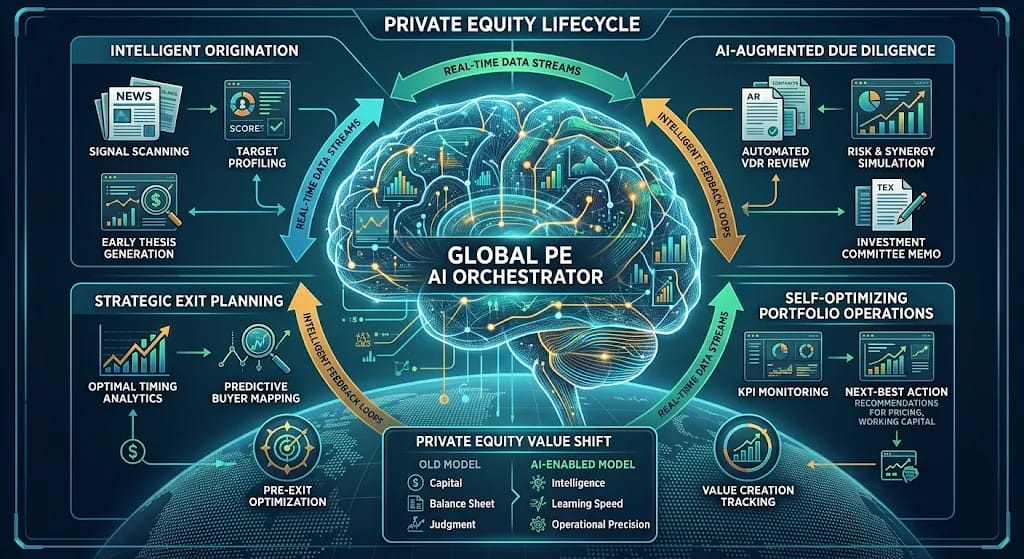
AI can support these objectives throughout the investment lifecycle.
A 2026 FTI Consulting Private Equity AI Radar report, based on 200 fund and operating leaders, found that 95% of surveyed funds reported AI initiatives meeting or exceeding their original business case criteria. Revenue acceleration was identified as the leading AI value-creation priority by 41% of respondents.
However, adoption is not equally advanced across the industry. Some firms have moved beyond experimentation, while others are still testing individual AI applications. <Cite refs={[“turn316015view0″,”turn426669view6”]}/>
The transformation is particularly visible in five areas:
Investment research: AI helps examine industries, competitors, financial information, and market developments.
Deal sourcing: Intelligent systems can identify businesses that match an investment firm’s preferred criteria.
Due diligence: AI assists with reviewing documents, contracts, financial records, and operational information.
Portfolio management: Predictive analytics can help monitor business performance and identify potential problems.
Value creation: AI automation can improve productivity, customer service, sales processes, and operating efficiency.
Together, these applications are changing how private equity firms evaluate investments and manage businesses.

3. Nine Major Applications of Private Equity Artificial Intelligence
AI has several practical applications across the investment lifecycle. The following areas explain where investment firms can use this technology.
1. AI-Powered Investment Research
Investment research requires analyzing industries, competitors, financial performance, economic conditions, and market opportunities.
AI-powered research platforms can process large amounts of information and organize findings into useful summaries.
For example, an investment team researching healthcare technology companies can use AI to identify market developments, compare business models, and examine competitive positioning.
This can help analysts spend less time collecting information and more time evaluating investment opportunities.
2. Automated Deal Sourcing
Deal sourcing involves identifying businesses that could become potential investment targets.
Traditionally, investment professionals depend on industry networks, financial databases, referrals, and direct business relationships.
AI can support this process by analyzing company profiles, market information, financial indicators, and industry developments.
Potential applications include:
- Identifying businesses within selected industries.
- Finding companies that match acquisition criteria.
- Screening potential investment opportunities.
- Organizing company information.
- Prioritizing prospects for further research.
Human investment professionals must still assess strategic suitability and establish business relationships.
3. AI-Powered Due Diligence
Due diligence is one of the most important stages of a private equity transaction.
Before acquiring a company, investors investigate its financial condition, legal obligations, customer relationships, operations, technology, and potential risks.
AI can help review large collections of documents and identify information that deserves additional attention.
For example, an AI document analysis system may compare financial statements across several years, identify inconsistent figures, and extract important contract terms.
This can make the review process more organized and efficient.
However, AI-generated findings should always be checked against original records by qualified professionals.
4. Predictive Financial Analysis
Predictive analytics uses historical and current information to estimate possible future outcomes.
Private equity professionals can use these systems to examine revenue patterns, operating expenses, cash flow, customer retention, and other financial indicators.
For example, a predictive model may help identify whether a portfolio company’s revenue growth is slowing or whether operating costs are increasing faster than expected.
These insights can support financial planning and scenario analysis.
Predictions are not guarantees. Their reliability depends on data quality, assumptions, and changing market conditions.
5. Portfolio Company Monitoring
After acquiring a business, private equity firms regularly monitor its performance.
AI can help collect and analyze information from financial reporting systems, customer databases, sales platforms, and operational software.
Investment teams can use dashboards to monitor:
- Revenue growth.
- Operating margins.
- Customer acquisition costs.
- Cash flow.
- Employee productivity.
- Customer retention.
- Operational performance.
Automated alerts can also highlight unusual changes that require management attention.
6. Generative AI for Investment Professionals
Generative AI can produce summaries, organize research, draft reports, and help employees interact with large collections of business information.
Private equity teams can use these tools to prepare investment research, summarize meeting notes, compare company documents, and develop preliminary presentations.
For example, an analyst could use an approved AI assistant to summarize a lengthy industry report and identify the main competitive factors.
The output should still be reviewed before it becomes part of an investment recommendation.
7. AI-Based Risk Management
Private equity investments involve financial, operational, legal, technological, and market risks.
AI can help identify unusual patterns in company data and support early risk detection.
Examples include:
- Unexpected increases in operating expenses.
- Changes in customer payment behavior.
- Unusual financial transactions.
- Cybersecurity warning signals.
- Supply chain disruptions.
- Changes in market demand.
AI does not eliminate investment risk, but it can help organizations investigate potential problems earlier.
8. Business Process Automation
Many portfolio companies perform repetitive administrative activities that consume employee time.
AI-powered automation can assist with invoice processing, customer support, reporting, document classification, and internal knowledge management.
For example, an organization may automate routine customer enquiries while allowing human employees to handle complicated cases.
This can improve productivity and allow employees to concentrate on higher-value activities.
9. AI-Supported Exit Planning
Private equity investors generally aim to improve a company’s value before selling their ownership stake.
AI can support exit preparation by organizing financial information, identifying operational improvements, evaluating market trends, and helping management prepare performance reports.
Potential buyers may also use AI to examine company information during their own due diligence.
The technology can therefore influence both sides of a transaction.
4. How AI Improves Private Equity Due Diligence
Due diligence deserves special attention because it involves evaluating a company’s condition before an investment decision is made.
Traditional due diligence can require significant time and coordination between financial analysts, accountants, legal advisers, technology specialists, and industry experts.
AI can support this work through several processes.
Document review: AI systems can classify and summarize financial statements, contracts, reports, and other business records.
Financial analysis: Machine learning can help identify unusual patterns, inconsistencies, and changes in financial performance.
Market research: AI tools can organize information about competitors, industry developments, and customer behavior.
Technology assessment: AI can help review software environments, technology dependencies, and cybersecurity documentation.
Risk identification: Automated analysis can highlight areas that deserve additional investigation.
However, an important distinction remains: AI-assisted due diligence is not the same as independently verified due diligence.
Investment teams must check source documents, confirm important information, and obtain professional legal, financial, and technical opinions where necessary.
As AI becomes more widely used, buyers are also examining whether target companies have appropriate AI governance, data protection, intellectual property arrangements, and cybersecurity controls.
5. How Private Equity Firms Create Value Through AI
Private equity investors do not simply acquire businesses. They also develop strategies to improve their performance.
This process is commonly called value creation.
AI can contribute to value creation in several ways.
Revenue Growth
AI-powered customer analytics can help businesses understand customer preferences, identify sales opportunities, and improve marketing decisions.
Companies may also use recommendation systems and predictive models to improve customer engagement.
Cost Reduction
Automation can reduce the amount of manual work involved in routine business processes.
Examples include automated reporting, invoice processing, document management, and customer service.
Improved Productivity
AI assistants can help employees complete research, prepare documents, organize information, and analyze business data.
Better Customer Experience
AI-powered support systems can provide faster responses and help businesses identify recurring customer problems.
Improved Management Decisions
Business leaders can use AI-generated insights to understand operational performance and evaluate different strategic scenarios.
A 2026 Boston Consulting Group study found that private equity-backed companies systematically building advanced AI capabilities across business functions had nearly twice the return on invested capital compared with companies that did not.
This is an association reported by BCG’s research, not a guarantee that adopting AI will automatically double investment returns. <Cite refs={[“turn316015view1″,”turn426669view2”]}/>
6. Best AI Technologies Used in Private Equity
Different AI technologies support different investment activities. Understanding their capabilities helps firms select appropriate solutions.
| AI technology | Main application | Potential benefit |
|---|---|---|
| Machine learning | Financial forecasting | Identifies patterns |
| Generative AI | Research and reporting | Speeds up knowledge work |
| Natural language processing | Document analysis | Extracts useful information |
| Predictive analytics | Portfolio monitoring | Supports forward-looking analysis |
| Robotic process automation | Repetitive workflows | Reduces manual tasks |
| AI agents | Workflow coordination | Automates multi-step processes |
| Data analytics | Investment evaluation | Improves business visibility |
Some widely recognized technology providers offer tools that can support private equity workflows.
Examples include Microsoft, Google Cloud, Amazon Web Services, and specialized financial data and analytics platforms.
The right choice depends on the firm’s existing systems, security requirements, investment strategy, data quality, and budget.
There is no single AI platform that is automatically suitable for every private equity organization.
7. Benefits and Challenges of AI in Private Equity
Although private equity artificial intelligence offers significant opportunities, implementation requires careful planning.
Main Benefits
Faster research: AI can help investment teams process large collections of information.
Operational efficiency: Automation reduces repetitive administrative activities.
Improved monitoring: Data analytics can help identify changes in portfolio company performance.
Better information management: AI can organize documents and make internal knowledge easier to access.
More informed decisions: Predictive analytics can support financial and operational planning.
Scalable processes: Successful AI workflows can potentially be adapted across multiple portfolio companies.
Main Challenges
Data quality: Inaccurate, incomplete, or outdated information can produce unreliable AI results.
Cybersecurity: Investment firms handle sensitive financial and commercial information that requires strong protection.
Regulatory compliance: AI applications must be assessed against relevant privacy, financial, and AI-related requirements.
Implementation costs: Enterprise AI systems may require software, infrastructure, integration, and specialist employees.
Skills shortages: Employees need training to understand and use AI responsibly.
Human oversight: Important investment decisions should not depend entirely on unverified AI-generated recommendations.
Grant Thornton’s 2026 Private Equity AI Impact Survey highlights the gap between AI experimentation and measurable business results. It reports that 46% of private equity leaders are scaling AI across functions, while only 24% report revenue growth from AI. It also identifies governance confidence as an important weakness. <Cite refs={[“turn316015view2″,”turn426669view4″,”turn426669view5”]}/>
These findings demonstrate why successful AI adoption requires more than purchasing new software.
8. How Private Equity Firms Can Implement AI Successfully
A successful AI strategy should begin with business objectives rather than technology trends.
Private equity firms can follow a structured implementation process.
Step 1: Identify Business Opportunities
Examine investment workflows and portfolio company operations to identify activities that could benefit from AI.
Prioritize problems that have measurable financial or operational consequences.
Step 2: Evaluate Data Readiness
Check whether the organization has reliable, accessible, and appropriately protected data.
Poor data quality can undermine even sophisticated AI systems.
Step 3: Select Suitable AI Tools
Choose technology based on the intended application.
A document analysis platform, predictive analytics system, and AI customer service assistant solve different problems.
Step 4: Start With a Pilot Project
Begin with a limited implementation rather than immediately changing every business process.
For example, test AI-assisted document review in one investment team or automate a specific reporting workflow in one portfolio company.
Step 5: Establish Governance
Create policies covering data access, cybersecurity, employee responsibilities, output verification, and human approval.
For additional guidance, read our article on 5 Reasons AI Transformation Is a Problem of Governance.
Step 6: Train Employees
Employees should understand how AI works, where it can make mistakes, and which information must not be entered into unauthorized systems.
Step 7: Measure Business Results
Track measurable outcomes such as:
- Time saved per workflow.
- Reduction in processing costs.
- Revenue growth.
- Improvement in reporting accuracy.
- Customer retention.
- Employee productivity.
Step 8: Expand Successful Projects
Once a pilot demonstrates measurable value, consider expanding it to additional departments or portfolio companies.
This approach helps organizations control implementation risk and avoid investing heavily in systems that do not solve meaningful business problems.
9. Future of Private Equity Artificial Intelligence: What to Expect Beyond 2026
The relationship between artificial intelligence and private equity is likely to become more important as AI systems improve.
One major development is agentic AI.
Unlike traditional tools that respond to individual instructions, AI agents can perform sequences of connected tasks within defined permissions.
For example, an investment research agent might collect public company information, organize financial data, summarize industry developments, and prepare a preliminary research report for an analyst.
Human professionals would still need to validate the findings and make important investment decisions.
Another development is the integration of AI into portfolio company operations.
Rather than using separate AI tools for individual tasks, businesses may increasingly connect AI systems with finance, sales, operations, customer service, and internal knowledge platforms.
The future may also bring:
- More advanced predictive financial models.
- AI-assisted investment screening.
- Automated portfolio reporting.
- Better cybersecurity monitoring.
- More sophisticated document intelligence.
- AI-supported operational planning.
- Greater demand for AI governance specialists.
PwC’s 2026 research identifies digitalisation and AI as the leading planned return driver among surveyed European private equity firms, with 83% planning to use data analytics and generative AI in due diligence during 2026. <Cite refs={[“turn316015view3″,”turn426669view7”]}/>
Nevertheless, technology adoption alone will not guarantee better investment performance.
Successful firms will need strong management, reliable data, appropriate infrastructure, skilled employees, and measurable implementation plans.
Frequently Asked Questions About Private Equity Artificial Intelligence
1. What is private equity artificial intelligence?
Private equity artificial intelligence refers to using AI technologies in investment research, deal sourcing, due diligence, portfolio management, risk assessment, and business improvement. It helps investment professionals analyze information and automate selected business processes.
2. How is AI used in private equity?
AI is used to analyze financial information, identify potential acquisition targets, review documents, monitor portfolio companies, forecast business performance, and automate administrative workflows.
3. Can artificial intelligence replace private equity analysts?
AI can automate certain research and analytical tasks, but it cannot fully replace professional judgment, negotiation, strategic thinking, or accountability. Analysts remain important for validating information and evaluating investment opportunities.
4. What are the benefits of AI in private equity?
Major benefits include faster research, improved financial analysis, more efficient due diligence, better portfolio monitoring, automated reporting, and improved operational productivity.
5. What is AI-powered due diligence?
AI-powered due diligence uses artificial intelligence to organize, analyze, and review company information before an investment. It can help examine contracts, financial records, business reports, and operational data.
6. What are the risks of using AI in private equity?
Important risks include inaccurate outputs, poor-quality data, cybersecurity threats, privacy concerns, regulatory compliance issues, and overreliance on automated recommendations.
7. What is the future of AI in private equity?
The future is likely to include greater use of AI agents, predictive analytics, automated portfolio monitoring, intelligent research platforms, and AI-supported business transformation.
8. Does AI guarantee higher private equity returns?
No. AI can support better analysis and operational improvements, but investment returns depend on many factors, including purchase price, management quality, market conditions, execution, and financial performance.
Conclusion
Private equity artificial intelligence is changing how investment firms identify opportunities, evaluate businesses, manage portfolios, and create value.
In 2026, AI is becoming an increasingly important part of the investment lifecycle. Its applications include automated due diligence, financial forecasting, portfolio monitoring, generative AI research, and business process automation.
However, successful implementation requires more than adopting advanced technology. Firms must also invest in reliable data, cybersecurity, employee training, governance, and human oversight.
The most successful private equity organizations will likely be those that combine AI capabilities with experienced investment professionals and disciplined business strategies.
As artificial intelligence continues to evolve, its role in private equity will extend beyond operational efficiency toward more informed investment decisions and sustainable portfolio growth.