
Most content teams in 2026 face the same problem: deadlines keep shrinking, search engines keep getting smarter, and readers can spot generic, robotic writing in seconds. Hiring enough human writers to keep up with blogs, product pages, social captions, and email campaigns simply isn’t realistic for most budgets. This is exactly where AI writing tools come in. The right AI writing tool doesn’t just fill a blank page faster — it helps you research, outline, optimize for SEO, and polish your voice, so your team can publish more without sacrificing quality. In this guide, we tested, compared, and researched the top platforms on the market so you can match the right tool to your workflow, whether you’re a solo blogger, an SEO specialist, or a marketing team scaling content production.
What Are AI Writing Tools?
AI writing tools are software platforms built on large language models (the same technology behind ChatGPT, Claude, and Gemini) that generate, edit, or optimize written content based on a prompt or brief. Instead of starting from a blank page, you give the tool a topic, a keyword, or a set of instructions, and it produces a draft, outline, or suggestion in seconds. Modern platforms layer extra functionality on top of the raw model — brand voice settings, SEO scoring, keyword research, plagiarism checks, and workflow integrations — which is what separates a general chatbot from a purpose-built content platform.
How We Selected the Best AI Writing Tools
Following an experience-first, expertise-driven approach consistent with Google’s quality guidelines, each tool on this list was evaluated against five criteria:
- Output quality — Does the content sound natural, varied, and free of repetitive filler?
- SEO and search readiness — Does the tool support keyword research, content briefs, and on-page optimization?
- Workflow fit — Does it integrate with a CMS, browser, or team collaboration tools?
- Value for price — Does the free or paid tier deliver enough functionality to justify the cost?
- Trust and transparency — Does the company publish clear data-handling and originality practices?
How We Selected the Best AI Writing Tools
Following an experience-first, expertise-driven approach consistent with Google’s quality guidelines, each tool on this list was evaluated against five criteria:
- Output quality — Does the content sound natural, varied, and free of repetitive filler?
- SEO and search readiness — Does the tool support keyword research, content briefs, and on-page optimization?
- Workflow fit — Does it integrate with a CMS, browser, or team collaboration tools?
- Value for price — Does the free or paid tier deliver enough functionality to justify the cost?
- Trust and transparency — Does the company publish clear data-handling and originality practices?
Best AI Writing Tools in 2026
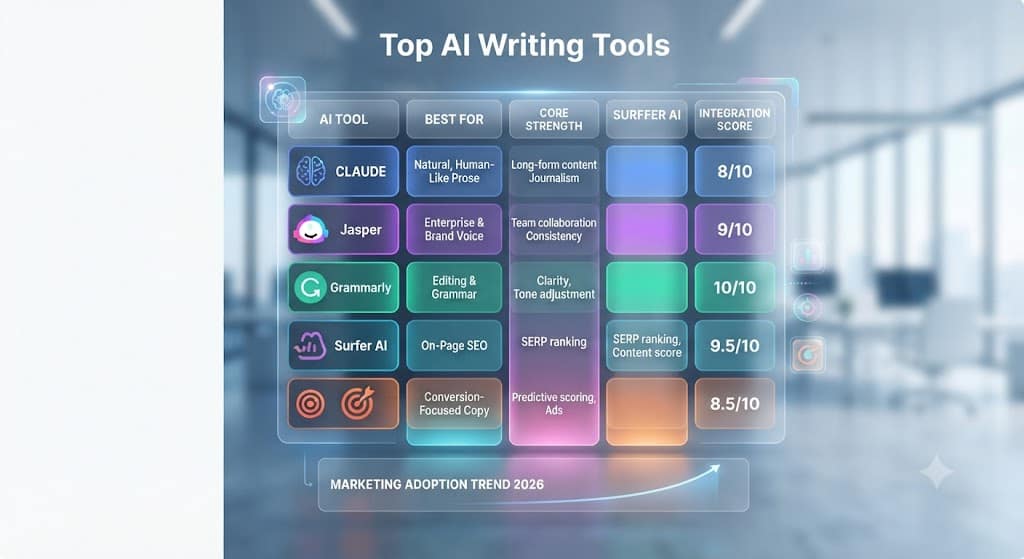
1. Claude (Anthropic) — Best Overall for Natural, Human-Like Content
Claude has earned a reputation among professional writers and bloggers for producing prose that reads like it was written by a person, not a template. It requires the least editing of any tool on this list, which makes it a strong pick for thought leadership, long-form articles, and journalism-style content. It isn’t purpose-built for SEO scoring, so pairing it with a keyword research tool is recommended for search-focused projects.
2. Jasper — Best for Enterprise Content Teams & Brand Voice
Jasper remains one of the most complete content ecosystems available, combining templates, brand voice training, team collaboration, and workflow automation. It’s a strong fit for marketing departments that need consistent tone across dozens of writers and channels, though the price point puts it out of reach for solo creators.
3. Grammarly — Best for Editing & Grammar
Grammarly has evolved from a simple grammar checker into a full AI-powered writing assistant. Its browser extension, desktop app, and add-ins catch clarity issues, tone mismatches, and plagiarism across almost every writing surface you use. It’s less useful for generating content from scratch, but nearly essential as a final editing layer.
4. Surfer AI — Best for On-Page SEO Optimization
Surfer analyzes top-ranking pages for your target keyword and turns that data into structural recommendations — headings, word count, keyword density, and related terms. Its Content Editor scores your draft in real time, which makes it easier to write content that’s genuinely competitive against page-one results rather than guessing at “best practices.”
5. Frase — Best for SEO Content Briefs
Frase is built around the content pipeline: research, outline, write, and optimize, all in one interface. If you’re managing a team of freelance writers, its brief-generation feature is one of the fastest ways to hand off a keyword and get back an on-brief, well-structured draft.
6. Writesonic — Best for SEO + AI Search Visibility (GEO)
Writesonic pairs an article-writer workflow with a visibility dashboard that shows how your brand is being referenced (or ignored) by AI systems like ChatGPT and Perplexity. That dual focus on traditional SEO and generative engine optimization (GEO) makes it a forward-looking choice, even though its prose quality still trails top-tier writing platforms.
7. Copy.ai — Best for Short-Form Marketing & Ad Copy
Copy.ai is built for marketers who need punchy, high-volume output: social captions, ad variations, and product descriptions. It’s less suited to long-form blog writing but excels at go-to-market workflows that mix sales and marketing copy.
8. ChatGPT — Best All-Purpose Writing Assistant
ChatGPT remains the most versatile tool on this list. It’s equally useful for brainstorming, research, first drafts, and even code, but it isn’t specialized for any single content task the way the other tools here are, so heavy SEO or brand-voice workflows may need an added layer of tooling.
9. Anyword — Best for Conversion-Focused Copy
Anyword’s predictive performance scoring estimates how well a piece of copy will convert before you publish it. That makes it the strongest option on this list for landing pages, paid ads, and sales emails, where measurable conversion — not just readability — is the goal.
10. Writer — Best for Enterprise Governance & Brand Compliance
Writer focuses on enterprise content governance: style guide enforcement, terminology control, and brand compliance across large writing teams. It’s overkill for a solo blogger but valuable for regulated industries that need consistent, on-brand language at scale.
11. Rytr — Best Budget-Friendly Option
Rytr delivers solid, template-driven output at one of the lowest price points in the category. It won’t out-write premium tools on nuance or depth, but for short-form content and tight budgets, it’s a dependable starting point.
12. Sudowrite — Best for Fiction & Creative Writing
Sudowrite is purpose-built for novelists and storytellers rather than marketers. Its brainstorming and “continue my story” features adapt to an author’s unique voice, and its visual world-building tools help with plotting and description, though output typically needs more editing than business-focused tools.
13. Wordtune — Best for Beginners
Wordtune’s strength is simplicity — you paste in a sentence or paragraph and it offers rewrite suggestions in different tones instantly. It’s an approachable entry point for anyone new to AI writing tools who wants to improve existing text rather than generate new content.
14. Clearscope — Best for Content Optimization
Clearscope remains one of the most trusted tools for aligning existing content with search intent. It doesn’t generate full drafts the way other tools on this list do, but its optimization reports are considered an industry benchmark for content teams focused on ranking improvements.
15. Koala AI — Best for Fast SEO Blog Publishing
Koala AI is designed to take a keyword to a publish-ready, SEO-structured blog post in minutes, complete with internal linking suggestions. For teams publishing at scale, it’s one of the fastest routes from keyword research to a live post.
How to Choose the Right AI Writing Tool for Your Needs

There’s no single “best” AI writing tool for every use case — the right pick depends on what you’re actually trying to produce:
- For SEO-driven blog content: prioritize tools with keyword data and content briefs, like Surfer AI, Frase, or Koala AI.
- For marketing and ad copy: look at Copy.ai or Anyword for speed and conversion-focused output.
- For long-form, natural-sounding writing: Claude and ChatGPT lead on prose quality and versatility.
- For editing and polish: add Grammarly as a final layer regardless of which generator you use.
- For fiction and creative projects: Sudowrite is purpose-built for storytellers.
Many teams get the best results by combining two or three tools rather than relying on one — for example, drafting with Claude, optimizing with Surfer AI, and editing with Grammarly.
Benefits and Limitations of AI Writing Tools
AI writing tools offer real efficiency gains: faster first drafts, lower content production costs, and consistent output across channels and non-writers on your team. But they come with responsibilities. Outputs can occasionally repeat patterns from their training data, so originality checks matter. Quality still depends on human oversight — AI can’t replace lived experience, original research, or nuanced judgment, which are exactly the signals Google’s quality rater guidelines reward. According to industry analysis from Search Engine Journal, the most successful content teams treat AI as a collaborative drafting partner rather than a replacement for editorial judgment — using it to speed up research and structure while keeping a human responsible for accuracy, expertise, and final review.
If you want a deeper breakdown of how these generators actually work under the hood, our earlier guide on AI writing generators covers the underlying technology and integration tips in more detail. For teams building a broader content strategy around these tools, it’s also worth reviewing your overall content marketing tools stack and SEO workflow to make sure AI-generated drafts fit into a process with proper human review — replace these two links with your own published articles on those topics if available.
Conclusion
The best AI writing tool for you depends entirely on what you’re producing and how your team already works. If you want the most natural, least-edited prose, Claude and ChatGPT are the strongest general-purpose picks. If SEO performance is the priority, Surfer AI, Frase, and Koala AI are built specifically for that job. Marketers chasing conversions should look at Copy.ai and Anyword, while Grammarly belongs in almost every stack as a final editing pass. Rather than searching for one tool to do everything, the smartest content teams in 2026 are combining two or three specialized platforms — drafting, optimizing, and editing — to publish faster without losing the human expertise that keeps content trustworthy and worth reading.
Frequently Asked Questions
1. What is the best AI writing tool overall in 2026?
There’s no universal winner, but Claude and ChatGPT are consistently rated highest for natural, human-sounding output, while Jasper leads for feature-rich, enterprise-scale content operations.
2. Are AI writing tools good for SEO content?
Yes, when paired with the right features. Tools like Surfer AI, Frase, and Clearscope analyze top-ranking pages and provide keyword, structure, and content-depth recommendations that generic AI chatbots don’t offer on their own.
3. Can AI writing tools replace human writers?
No. AI writing tools speed up drafting, research, and optimization, but human editors are still needed to verify facts, add original expertise and experience, and ensure the content reflects genuine brand voice and accuracy.
4. Do AI writing tools produce plagiarism-free content?
Most reputable tools include originality or plagiarism checks, but no AI tool can guarantee 100% unique output every time. Running generated content through a dedicated plagiarism checker before publishing is still good practice.
5. Which AI writing tool is best for beginners on a budget?
Wordtune and Rytr are the most beginner-friendly and affordable options, offering simple interfaces and low-cost plans without the steep learning curve of enterprise platforms like Jasper or Writer.