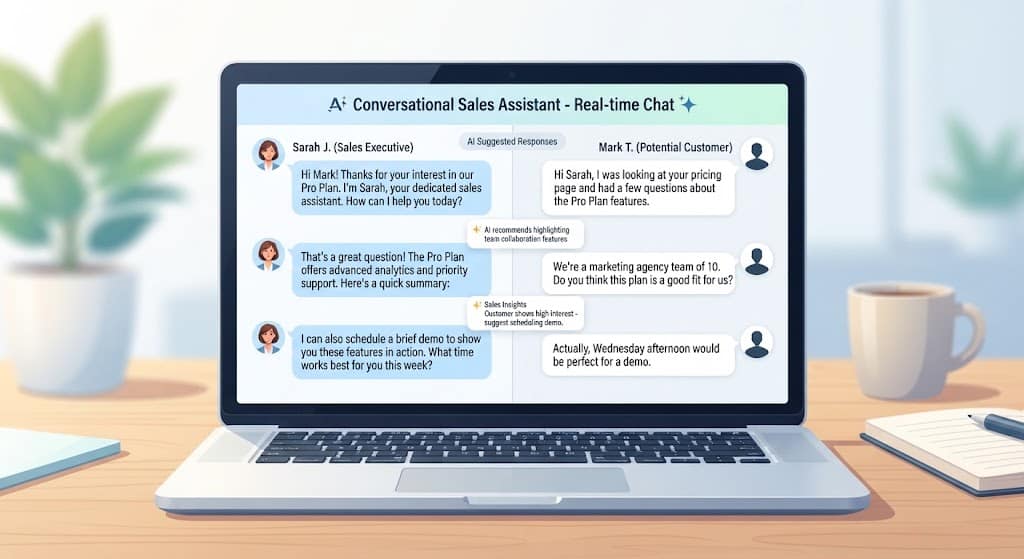
Businesses are constantly looking for better ways to connect with potential customers, answer questions quickly, and turn website visitors into qualified leads. SalesChat is one approach that combines live chat, conversational automation, and AI-powered assistance to support the sales process.
Instead of waiting for visitors to complete a contact form or send an email, sales chat lets businesses engage with prospects while they are actively browsing a website or considering a product.
Depending on the platform, SalesChat can answer questions, recommend products, collect lead information, qualify prospects, schedule meetings, and transfer conversations to human sales representatives.
In this guide, you’ll learn what SalesChat is, how it works, what businesses use it for, its key benefits, and what to consider before choosing a sales chat solution.
What Is SalesChat?
SalesChat refers to a chat-based sales communication system that helps businesses engage with potential customers through website conversations and other digital channels.
An AI-powered sales chat system can use natural language processing to identify the intent behind these questions.
The main purpose is to make sales conversations easier to start and continue.
For example, a visitor might arrive on a product page and have a question about pricing, features, delivery, or compatibility. Instead of leaving the website to search for an answer, the visitor can start a conversation directly.
A sales chat system may then:
- Answer common product questions
- Identify what a visitor is looking for
- Collect contact information
- Qualify potential leads
- Recommend relevant products or services
- Schedule a sales call or demonstration
- Transfer complex questions to a human representative
- Follow up with prospects when supported by the platform
This makes SalesChat particularly useful for businesses where timely conversations can influence purchasing decisions.
How Does SalesChat Work?
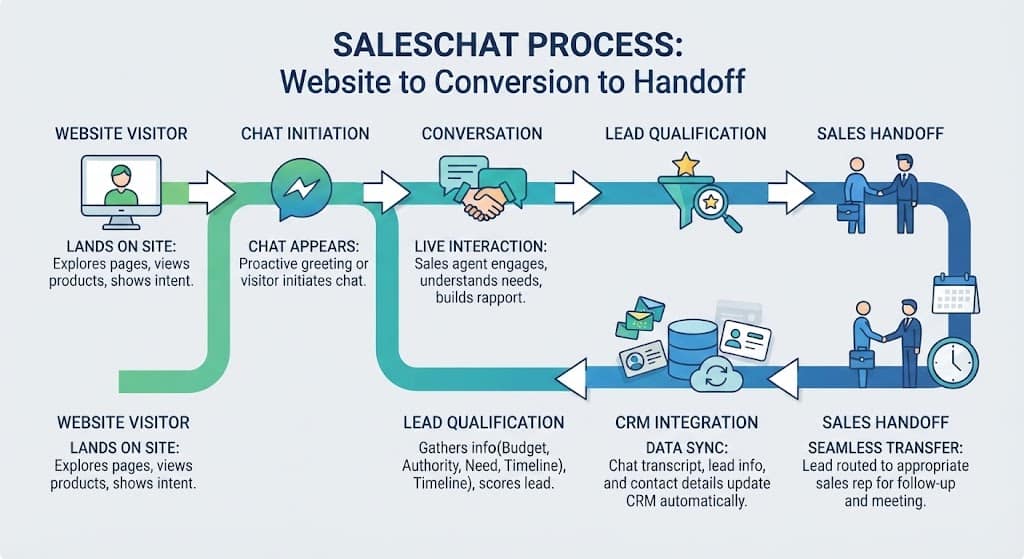
SalesChat can work differently depending on the platform, but most systems follow a basic conversational process.
1. A Visitor Starts a Conversation
The process often begins when a visitor opens a chat window or interacts with an automated chat invitation.
The conversation can be initiated by the visitor or, depending on the platform, triggered by specific website behavior.
For example, a visitor spending significant time on a pricing page may be shown an invitation to ask a question.
2. The System Identifies the Visitor’s Intent
The next step is understanding what the visitor wants.
A prospect may ask:
- Which plan is best for a small business?
- Do you offer a free trial?
- Can I book a product demo?
- Does this service integrate with my existing software?
- How much does it cost?
An AI-powered sales chat system can use natural language processing to identify the intent behind these questions.
3. SalesChat Provides an Answer
The system can respond using different methods.
Depending on the platform, answers may come from:
- Predefined responses
- Product or company knowledge bases
- Decision trees
- AI-generated responses
- Human sales representatives
- Hybrid workflows
For important sales information, businesses should make sure that the system has access to accurate and up-to-date information.
4. The Prospect Can Be Qualified
SalesChat can also ask qualifying questions.
For example:
- What type of business do you operate?
- How many users do you need?
- What solution are you looking for?
- What is your expected timeline?
- Would you like to speak with a sales representative?
The answers can help determine whether a visitor is a potential sales opportunity.
5. The Conversation Moves to the Next Step
Once a prospect is qualified, the system can guide them toward an appropriate action.
That might include:
- Booking a meeting
- Requesting a demonstration
- Starting a trial
- Requesting a quote
- Contacting a sales representative
- Completing a purchase
The exact capabilities depend on the SalesChat platform and its integrations.
SalesChat vs Traditional Live Chat
SalesChat and live chat can look similar from a visitor’s perspective, but their goals can be different.
| Feature | Traditional Live Chat | SalesChat |
|---|---|---|
| Main purpose | General assistance | Sales engagement |
| Primary users | Support and website visitors | Prospects and sales teams |
| Lead qualification | Limited | Core use case |
| Product recommendations | Sometimes | Common use case |
| Sales questions | May require an agent | Often supported directly |
| Automation | Varies | Frequently included |
| CRM integration | Platform dependent | Often important |
| Meeting booking | Sometimes | Common sales workflow |
| Human handoff | Support-focused | Sales-focused |
The distinction is not absolute. A live chat platform can support sales, while a SalesChat solution can also provide customer support.
The difference usually comes down to how the conversation is designed and what business outcome it is intended to support.
Where Is SalesChat Used?
SalesChat can be useful across many industries and business models.
E-Commerce
Online stores can use sales chat to help shoppers make purchasing decisions.
A visitor may ask about:
- Product specifications
- Sizes and compatibility
- Shipping
- Returns
- Discounts
- Product comparisons
A conversational assistant can help answer these questions and guide the shopper toward an appropriate product.
SaaS Businesses
Software companies often use sales chat to answer questions about plans, features, integrations, pricing, and demonstrations.
A visitor who is interested in a product can potentially move directly from a website conversation to a demo or sales call.
Service Businesses
Agencies, consultants, financial service providers, marketing companies, and other service businesses can use SalesChat to identify potential clients and collect initial project information.
Instead of relying only on a contact form, the business can start a conversation with the prospect immediately.
B2B Sales
B2B companies often have longer buying processes and multiple decision-makers.
SalesChat can help collect basic information, identify potential business needs, and route qualified prospects to the appropriate sales team.
Education and Training
Training providers and educational businesses can use conversational systems to answer questions about courses, schedules, pricing, enrollment, and available programs.
7 Key Benefits of SalesChat
SalesChat can provide several practical advantages when it is implemented correctly.
1. Engage Visitors in Real Time
One of the biggest advantages is the ability to communicate with prospects while they are already on the website.
Instead of waiting for a visitor to submit a form, businesses can begin a conversation immediately.
2. Capture More Leads
Some visitors may avoid traditional forms because they require too much effort.
A conversational approach can collect essential information through a series of simple questions.
3. Qualify Prospects Automatically
Sales teams can spend significant time dealing with leads that are not a good fit.
SalesChat can ask qualifying questions before passing a prospect to a salesperson, helping teams prioritize potentially valuable opportunities.
4. Answer Questions Faster
A visitor who cannot find an answer may leave a website.
SalesChat can provide immediate answers to common questions and help visitors continue their buying journey.
5. Reduce Repetitive Sales Work
Sales representatives often answer the same questions repeatedly.
Automated SalesChat can handle suitable routine conversations, allowing sales professionals to focus on more complex discussions and qualified opportunities.
6. Support 24/7 Lead Engagement
Automated chat systems can remain available outside normal sales-team working hours.
This can be particularly useful for businesses serving customers across different countries and time zones.
7. Improve the Sales Journey
When conversations, lead qualification, product information, and scheduling are connected, the buying process can become more straightforward for potential customers.
The actual results depend on the quality of the implementation, website traffic, offer, sales process, and the accuracy of the information provided by the system.
How Can SalesChat Improve Lead Generation?
Lead generation is one of the strongest applications for sales chat.
A traditional website may ask visitors to:
- Find the contact page
- Open a form
- Enter their information
- Submit the form
- Wait for a response
A conversational system can make this process more interactive.
For example:
Visitor: I’m looking for software for a small team.
SalesChat: How many people will be using the software?
Visitor: About 10.
SalesChat: Would you like to compare plans or speak with a product specialist?
This type of interaction can help businesses understand visitor needs before passing the conversation to a sales representative.
However, automated qualification should remain short and relevant. Asking too many questions can make the experience feel like a longer version of a traditional form.
SalesChat and AI Sales Assistants
Modern SalesChat platforms may use artificial intelligence to make conversations more flexible.
An AI sales assistant can potentially:
- Understand natural language
- Answer product questions
- Summarize conversations
- Identify buying intent
- Recommend relevant information
- Collect lead details
- Assist sales representatives
Some systems can also connect to company knowledge bases or customer relationship management platforms.
However, AI should not be trusted blindly with important sales information. Pricing, product availability, contract terms, discounts, and other business-critical information should come from reliable sources.
SalesChat and CRM Integration
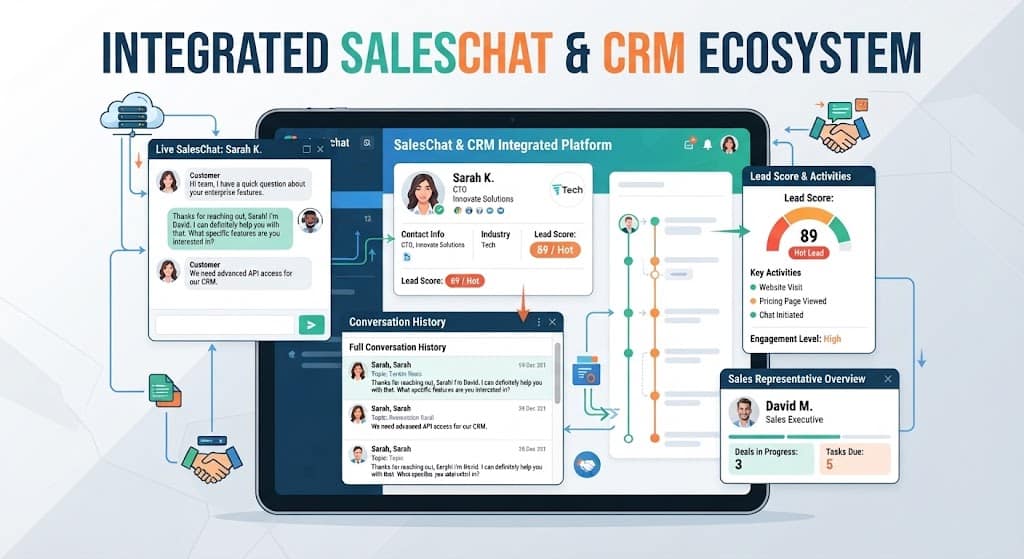
CRM integration can make SalesChat more useful for sales teams.
When supported, a chat platform may send information such as:
- Name
- Email address
- Company
- Conversation history
- Lead source
- Product interest
- Qualification information
to a CRM or sales system.
This allows sales representatives to understand the context of a lead before starting a follow-up conversation.
Without proper integration, sales teams may have to manually copy information from the chat system into their CRM, which can reduce efficiency and create data-quality problems.
Common SalesChat Mistakes to Avoid
Not every sales chatbot creates a better customer experience.
Asking Too Many Questions
Visitors do not want to complete a long questionnaire inside a chat window.
Only ask questions that help move the conversation forward.
Giving Generic Answers
A SalesChat system that responds with vague marketing language can frustrate potential customers.
Answers should be specific, useful, and based on reliable business information.
Hiding the Human Option
Some conversations need a real sales representative.
Make it easy for visitors to request human assistance when appropriate.
Using Aggressive Pop-Ups
Constantly interrupting visitors with chat invitations can damage the user experience.
Chat triggers should be relevant to the visitor’s behavior and the page they are viewing.
Ignoring Conversation Data
Chat conversations can reveal valuable information about what customers want and where they experience problems.
Businesses should review conversations regularly to identify recurring questions and improve their sales process.
What Should You Look for in a SalesChat Platform?
Before choosing a sales chat solution, evaluate its capabilities carefully.
AI and Automation
Check whether the platform supports the level of automation your business actually needs.
Lead Qualification
Look for flexible workflows that allow you to define qualifying questions and lead-routing rules.
CRM Integration
Make sure the platform can connect with the CRM and sales tools your team already uses.
Human Handoff
The system should provide a clear path to a human representative when automation is not enough.
Analytics
Useful analytics can show:
- Number of conversations
- Lead sources
- Common questions
- Qualification results
- Conversion activity
- Human handoffs
Customization
The chat experience should match your website design and brand voice.
Data Privacy and Security
Businesses should understand how conversation data is stored, processed, protected, and shared.
This becomes particularly important when conversations contain personal or sensitive customer information.
FAQs About SalesChat
What is SalesChat?
SalesChat is a chat-based sales communication approach that helps businesses engage website visitors, answer questions, capture leads, qualify prospects, and guide potential customers toward the next step in the buying process.
Is SalesChat the same as a chatbot?
Not necessarily. A chatbot is a broader term for automated conversational software. SalesChat specifically focuses on sales-related conversations, such as lead generation, qualification, product assistance, and appointment booking.
Can SalesChat generate leads?
Yes. Depending on the platform, SalesChat can collect contact information, ask qualification questions, identify potential buying intent, and route suitable leads to a sales team.
Can SalesChat replace sales representatives?
It generally works best as a sales-assistance tool rather than a complete replacement for sales representatives. Automated chat can handle routine interactions, while human representatives can manage complex negotiations, objections, and high-value conversations.
Can SalesChat connect to a CRM?
Many sales chat platforms support CRM integrations, although available integrations vary by provider. Businesses should verify compatibility with their existing CRM before choosing a platform.
Is SalesChat useful for small businesses?
It can be. Small businesses can use sales chat to answer common questions, capture leads, and remain available outside normal working hours without requiring a large sales team.
Does SalesChat use artificial intelligence?
Some SalesChat solutions use AI, while others rely primarily on predefined workflows or a combination of automation and human agents. The technology depends on the specific platform.
The Future of SalesChat
Sales conversations are becoming increasingly digital and conversational.
Future SalesChat systems are likely to combine AI assistants with CRM data, product information, analytics, voice interfaces, and automated workflows.
Instead of simply answering questions, conversational sales systems may increasingly help prospects move through multiple stages of the buying process.
For example, a single conversation could potentially allow a visitor to:
- Ask about a product
- Compare available options
- Receive relevant recommendations
- Provide basic requirements
- Book a sales demonstration
- Continue the conversation with a human representative
At the same time, businesses will need to pay attention to accuracy, transparency, privacy, and responsible use of customer data.
The most effective SalesChat systems will not simply try to automate every sales conversation. They will combine automation with human expertise where it creates the best experience.
Final Thoughts
SalesChat provides businesses with a conversational way to engage potential customers, answer questions, capture leads, and support the sales process.
Its biggest advantage is timing. Instead of waiting for a prospect to submit a form or contact the company later, businesses can start a conversation while the visitor is actively exploring a product or service.
When combined with accurate information, useful qualification workflows, CRM integration, analytics, and human sales support, this technology can become a valuable part of a modern sales strategy.
The goal should not be to automate every interaction. The better approach is to use conversational tools for the conversations they can handle effectively while giving qualified or complex prospects a smooth path to a real sales professional.